Showing posts with label cinema. Show all posts
Showing posts with label cinema. Show all posts
Thursday, March 06, 2008


Sunday, March 02, 2008
Sunday, January 06, 2008
I've been watching Hitchcock's "The Paradine Case" on cable and caught this amazing crypto-queer exchange:
Handsome Gregory Peck: I came on you quite by accident.
Gorgeous Louis Jourdan: But you wanted to come on me . . .
There's a very unusual feel to this film that must delight contemporary gender theorists: although it's about a woman who murders her husband due to her infatuation with another man, it depicts the men who bring her down as heartless and foolish. That kind of appreciation of moral ambiguity is very rare in Hollywood, outside of film noir. It's interesting to consider whether this alone qualifies the film as noir despite its sharing no other characteristics at all with the noir classics.
Saturday, September 15, 2007
From The Fortean Times
Curtis Harrington
Actor and photographer Lisa Jane Persky pays tribute to legendary B-movie director, avant-gardist and esotericist Curtis Harrington, and reports from a very strange memorial service.
By Lisa Jane Persky
August 2007
Curtis Harrington, director of famed weird B-movies such as Night Tide (1961), Games (1967), Who Slew Auntie Roo? (1971) and What’s the Matter With Helen? (1971) was one of very few avant-garde directors to successfully make the transition into commercial filmmaking. He passed away at the age of 80 in Hollywood on 6 May 2007 from complications related to a stroke he had suffered in 2005.
“HIDEOUS BEYOND BELIEF… with an INHUMAN CRAVING!” was the tagline for Harrington’s best known cult classic, Queen of Blood (1966); strangely, it could have been applied to his fellow avant-gardist and occult celebrity Kenneth Anger when he made an appearance at Harrington’s burial service last month.
I met Harrington in 2006, at an opening for Dennis Hopper’s photographs and paintings. We were introduced by Gregory Poe, a friend with an apt last name. Harrington was a lifelong fan of Edgar Allan Poe and he began and ended his career with different versions of 'The Fall of the House of Usher'. Gregory told me that he designed funeral urns and that Curtis had already ordered his. A year later, at the Forever Hollywood Cemetery adjacent to Paramount Studios, Harrington was ready to put Mr Poe’s handiwork to use.
Harrington’s memorial service was an open-casket affair held in the cemetery’s small chapel. Among other guests was Kenneth Anger, who arrived with a cameraman in tow. Best known for his films Fireworks, Inauguration of The Pleasure Dome (in which Harrington appeared, along side Anaïs Nin) and Lucifer Rising, Anger is also the author of two compendia of trashy Hollywood scandals, Hollywood Babylon and Hollywood Babylon II, and his name is often linked to those of Satanist Anton LaVey and the notorious Aleister Crowley.
According to Harrington’s executor, screenwriter Robert Mundy, Harrington and Anger had been ‘friends’ since childhood but had carried on a lifelong feud, during which Anger had repeatedly been cruel to Harrington. Because of this, as well as the attendant cameraman, Mundy asked Anger to leave. Anger informed Mundy that he would have to call the police to get him off the property. Eventually, they reached a compromise, and Anger turned off the camera. But this didn’t prevent him from kissing the embalmed face of Harrington or from taking a seat in the front row. Anger, who is also 80, looks hardy and sports the intense, bullet-headed look of Aleister Crowley in his later years.
Actor Jack Larson (Jimmy Olson in the 1950s Super man television series), who was to be the only speaker at the service, described the Hollywood milieu that he and Curtis entered in the 1940s. He had barely started when he was interrupted by Anger, who shouted juicy ‘corrections’ to Larson’s speech. Larson persevered as Anger continued to provide a running commentary in a we-of-the-theatre tone. Larson referred to a mutual friend, ‘Paul’ from Pasadena, who ran a ‘coven’ which attracted many people, including Harrington and himself. At this, Anger shouted “NO! NO! It was an order of the Ordo Templi Orientis and it was of as high a degree as 33rd degree Masonry. I am a 33rd-degree member through Crowley.” Previous to this, Larson had already mentioned Crowley and Anger had corrected his pronunciation: “Crow as in Crow. Then Lee.”
Larson mentioned that ‘Paul’ had supposedly created a homunculus. Anger agreed – “OH HE DID! I saw it. It held my hand. Its little hand, like a tentacle, wrapped itself around my finger. There were 33 others in the crib, but not in full-fruition like this one” – suggesting that degrees of Masonry and homunculi litter have something in common. A number of actresses were involved in the “coven”, one of whom reportedly saw the homunculus. Anger informed the guests that who ever sees a homunculus is henceforth responsible for its life, and this, he suggested, may be why she ultimately became a recluse.
Larson recounted that ‘Paul’ supposedly had a tail. Anger concurred. “I SAW IT!” he shouted. “I showed it to Kinsey and he said that wasn’t so unusual – one man in 50,000 has one.” In the 1950s, the sexologist Alfred Kinsey became interested in Anger and his films, and in 1955 the two visited the site of Crowley’s ‘Abbey of Thelema’ in Cefalu, Sicily.
According to Larson, ‘Paul’s’ home burned to the ground. Anger explained why. “HOWARD DID IT!” he exclaimed. “Howard Hughes, who was crazy because he had syphilis of the brain.” For once no one disagreed, although this did produce some uncomfortable laughter.
Toward the end of Larson’s speech, Anger announced that he and Harrington had both been dying of prostate cancer (although Harrington didn’t die of this) and that he had told Harrington that he would outlive him. Anger then informed everyone that his own memorial would be here, in the same place. He turned toward the crowd and said “Oh yes, It’s been confirmed. I know the date of my death. On Hallowe’en 2008. My memorial. RIGHT HERE! HALLOWE’EN 2008!” Then, as an afterthought, he added, “INVITATION ONLY! Sorry.”
Across from Anger’s seat was a huge floral bouquet. The card read: “For my old pal Kurtiz (sic) from his old rival Kenneth Anger”. The note, which usually bears the name of the deceased, read “Dr. Kenneth Anger,” making it look as though it was Anger’s funeral instead, well ahead of schedule. One of the themes Harrington explored in Queen of Blood and other films is that of beings who feed off others. With this in mind, one assumes that Anger won’t starve to death.
A second memorial service sans Anger was held at the Academy of Motion Picture Arts and Sciences on historic Vine Street. Speakers there included scream queen Barbara Steele, directors Peter Medak (The Krays) and Bill Condon (Dreamgirls), and Dennis Hopper, who appeared in Harrington’s early work Night Tide. This film also featured Marjorie Cameron, the widow of Jack Parsons, the scientist at Pasadena’s Jet Propulsion Laboratory who was also a follower of Aleister Crowley. Cameron appeared in Anger’s Inauguration of the Pleasure Dome and was part of the occult bohemia depicted in John Carter’s Sex and Rockets: The Occult World of Jack Parsons, and it’s quite possible that Parsons was the ‘Paul’ that Superman’s pal and Crowley’s devotee had argued about at the previous service. Parsons blew himself and his house up in an ‘accident’, although there are suspicions it may have been suicide. Then too, they may have been speaking of Paul Mathison, the art director and actor who played Pan in Inauguration of The Pleasure Dome.
In a short documentary screened at the Anger-free event, Harrington had the last word: “There is the exoteric and the esoteric… That’s what I’m interested in. The esoteric. What goes on beneath.” He also had a sense of humour. “Did you know,” the husband asks his wife in Games, “that Aimee Semple McPherson was buried with a telephone?” “Why?” “Just in case,” a nod, to be sure, to Poe’s “The Premature Burial.” Harrington is now entombed at Hollywood Forever in an urn made by another Poe, in which, sadly, there is no room for a telephone. The obituary in Variety claimed Harrington had no survivors, but this isn’t true. He has Anger, whether he wants him or not, along with a coterie of friends and admirers. Most importantly, he is survived by the prints of his films, which have been willed to The Motion Picture Academy.
Curtis Harrington, director and occultist, born 26 Sept 1927; died Hollywood 6 May 2007, aged 80.
Good Curtis Harrington bio at the Alternative Film Guide:
http://www.altfg.com/blog/directors/curtis-harrington/
Friday, August 10, 2007
American Movie Critics: An Anthology from the Silents Until Now, Phillip Lopate, ed.
William Troy, "King Kong"
". . . unfortunately, it was thought necessary to mitigate some of the predominant horror by introducing a human. all-too-human theme. 'It was not the guns that got him,' says one of the characters at the end, after Kong has been brought to ground by a whole squadron of battle planes. 'It was Beauty killed the Beast.' By having Beauty, in the person of Miss Wray lure the great monster to his destruction, the scenario writers sought to unite two rather widely separated traditions of the popular cinema--that of the 'thriller' and that of the sentimental romance. The only difficulty was that they failed to realize that such a union was possible only by straining our powers of credulity and perhaps one or two fundamental laws of nature. For if the love that Kong felt for the heroine was sacred, it suggests a weakness that hardly fits with his other actions; and if it was, after all, merely profane, it proposes problems to the imagination that are not the less real for being crude."
"The Invisible Man"
"A body without a voice we have had on the silent screen, but not until this picture have we had a voice without a body."
These are two perfect film reviews. Troy was primarily a literary critic, and his emphasis is on plot - "scenario." But he has a terrific sense of how the uniqueness of the film experience arises from the paradoxes inherent in processing a representation of the inner world of fantasy presented in realistic visual and aural form. In criticizing Kong, he identifies the distinctive feature in the film's approach to love and sex, but he considers it as an error rather than as the enactment of a fantasy; it realizes its power, but he disapproves of it. And on aesthetic grounds, he's probably right.
What's great in him is that he recognizes so clearly the impact of the illusionistic qualities of film and how they push us towards the kind of thinking we do about plot and character. The recognition of the bad fit--and that's very, very bad joke--between two visions of sexuality is indeed the key to the movie, and works well with the later revisionist views that see Kong as about race. This essay alone makes me much more enthusiastic about including the original Kong in the Sex in Cinema class. (Previously I used only an excerpt. It's great to compare with the "Hot Voodoo" number from Blonde Venus--the one quoted in The Dreamers.
Robert Warshow, "A Feeling of Sad Dignity"
On Chaplin's Monsieur Verdoux and Limelight
Ralph Ellison, "The Shadow and the Act"
Martha Wolfenstein and Nathan Leites, "Got a Match?"
On the "masculine-feminine" girl in movies
Parker Tyler, "Double into Quadruple Indemnity" and "Warhol's New Sex Film"
Of course I think there should be a lot more Tyler in this anthology. This is the famous essay on the relationship between Walter and Keyes in Double Indemnity; and the essay on Warhol is one of the most lucid explanations of what he was up to (addressing the film Fuck).
Susan Sontag, "The Imagination of Disaster"
American Movie Critics: An Anthology from the Silents Until Now, Phillip Lopate, ed.
Thursday, August 09, 2007
American Movie Critics: An Anthology from the Silents Until Now, Phillip Lopate, ed.
Vachel Lindsay, "The Photoplay of Action" and "The Artistic Position of Douglas Fairbanks and The Thief of Bagdad Production"
Lindsay seems like the definitively outdated, time-bound poet--those rhythmic incantations high-school students memorize--but his judgments on film are incredibly subtle, broad-minded, and far-seeing. The D. Fairbanks essay is a defense of Entertainment against the demands of Art.
Robert E. Sherwood, "The Ten Commandments" and "Greed"
"The Ten Commandments may not exercise as much influence as they should, but they are certainly good theater."
H. L. Mencken, "Note on Technic"
"What afflicts the movies is not an unpalatable ideational content so much as an idiotic and irritating technic. . . . How can one work up any rational interest in a fable that changes its locale and its characters ten times a minute? Worse, this dizzy jumping about is plainly unnecessary: all it shows is the professional incompetence of the gilded pants-pressers, decayed actors and other such half-wits to whom the making of movies seems to be entrusted. Unable to imagine a sequence of coherent scenes, and unprovided with a sufficiency of performers capable of playing them if they were imagined, these preposterous mountebanks are reduced to the childish device of avoiding action altogether. Instead of it they present what is at bottom nothing but a poorly articulated series of meaningless postures and grimaces. One sees a ham cutting a face, and the one sees his lady co-star squeezing a tear--and so on, endlessly. . . . If, at the first attempt upon a scene, the right attitude is not struck, then all they have to do is keep trying until they strike it. On those terms a chimpanzee could play Hamlet, or even Juliet.
"To most of the so-called actors engaged in movies, I daresay, no other course would be possible. . . . They are engaged, not for their histrionic skill, but simply for their capacity to fill the heads of romantic virgins and neglected wives with the sort of sentiments that the Christian religion tries so hard to put down. . . . The worst of it is that the occasional good actor, venturing into the movies, is brought down to the common level by the devices thus invented to conceal the incompetence of his inferiors. It is quite as impossible to present a plausible impersonation in a series of unrelated (and often meaningless) postures as it would be to make a sensible speech in a series of college yells. So the good actor, appearing in the films, appears to be almost as bad as the natural movie ham. One sees him only as one sees a row of telegraph poles, riding in a train. . . .
"All this is ingenious. More, it is humane, for it prevents the star trying to act, and so saves the spectators pain. But it is manifestly a poor substitute for acting on the occasions when acting is actually demanded by the plot--that is, on the occasions when there must be cumulative action, and not merely a series of postures. . . . In the movies they are dismembered, and so spoiled. Try to imagine the balcony scene from "Romeo and Juliet" in a string of fifty flashes--first Romeo taking his station and spitting on his hands, then Juliet with her head as big as a hay-wagon, then the two locked in a greasy kiss, then the Nurse taking a drink of gin, then Romeo rolling his eyes, and so on. If you can imagine it, then you ought to be in Hollywood, dodging bullets and amassing wealth. . . ."
This is very interesting to read in conjunction with Noel Carroll's A Philosophy of Mass Art, as I'm doing. Clement Greenberg and Adorno and Horkheimer's arguments against mass forms like movies turn on the idea that they make the audience intellectually lazy--Greenberg hilariously insists that the reception of real art should be hard work--where do they come up with these things?--while Adorno and Horkheimer more sensibly fear the cultivation of the habit of passive reception. An essay like Mencken's, coming relatively early in the history of film, clarifies the obvious point that the claim that mass media are easy or passive is bogus. (Carroll is very good at showing that the key terms in most of these arguments are incoherent, biased, or entirely artificial. He's also very good at briefly showing how Kant's ideas about aesthetic judgment are illegitimately extended to art--as if the objects of judgment should display the same characteristics as judgment does. I'm so poorly educated I never realized this before, but my excuse is that the arguments based on this mistake--like Greenberg's--always seemed to me so ridiculous that they were not worth considering in detail.)
Then there is this extraordinary diatribe:
"A successful movie mime is probably the most admired human being ever seen in the world. He is admired more than Napoleon, Lincoln or Beethoven; more, even, than Coolidge. The effects of this adulation, upon the mime himself and especially upon his clients, ought to be given serious study by competent psychiatrists, if any can be found. For there is nothing more corrupting to the human psyche, I believe, than the mean admiration of mean things. It produces a double demoralization, intellectual and spiritual. Its victim becomes not only a jackass, but also a bounder. The movie-parlors, I suspect, are turning out such victims by the million: they will, in the long run, so debauch the American proletariat that it will begin to put Coolidge above Washington, and Peaches Browning above Coolidge. . . ."
American Movie Critics: An Anthology from the Silents Until Now, Phillip Lopate, ed.
Friday, May 25, 2007
Ellenberger
 Henri Ellenberger, The Discovery of the Unconscious
53-74 Gassner and Mesmer. Enlightenment rationalism emerging in challenge to Gassner's "preternaturalist" explanation of "possession"; Mesmer's "rational"explanation of "animal magnetism." Mesmer's obscure involvement in politics 1785-1815. The notion that slave rebellion and thus Haitian independence were inspired by a mesmeric fad.
(Curiously, I dreamt of Haiti last night before reading about this this morning:
I am sitting in on a class at the Corcoran. The instructor doesn't know I'm also an instructor, and I'm appalled by her behavior: She keeps the class waiting while she finishes a personal phone during class time; she seems unsure and unconcerned about requirements and due dates; she seems to have a superficial grasp of her subject. Cory Hixson, Bob Devers, and Richard Wilkerson are sitting there, too, and all sort of acknowledge this isn't good but also "what can you do?" The instructor switches on a television for us to watch a video. On the screen I see a report about poverty, hunger, and political unrest in Haiti. There is an image of a kind of sculpture: a wooden board that has a largish metal bomb mounted on it pointing downwards, a bullet-shaped bomb with a tail, like a cartoon bomb dropped by a plane, very rusty, surmounted by a smaller bomb of the same shape, also pointing downwards. Mounted above the bomb are some leaves and vines, other things like twine, making a pattern that suggests a loincloth, like the bombs represent a cache-sexe holding a very large penis. The title is "Il met son front sur le fronton," and I understand that this means that the sculpture is a daring political joke about the military dictator, who has a phallic idea of power.
BTW, I immediately associate the loincloth with watching Walkabout last night, and the dictator (partly through the leaves and vines) with Bush, and my feeling that he is all balls, all nerve, with nothing else to back it up.
After I wake up, I don't know what the French phrase means. I have to look it up to get the sense it could mean "He puts his face (forehead) on a monument."
77-101 German Romantics - Clemens Brentano's book of the visions of Katharina Emmerich - The Seeress of Prevorst (von Eschenmayer?) - Kerner's inkblots (which could be a key precursor of the uncanny use of photography) - spiritualism - Bernheim against Charcot
Chapter 3 110-174 Multiple personalities, doubles (dipsychism)
Chapter 4 The philosophical and ideological background
The point of this is to depict the growth of cinema and psychoanalysis not just as coincident and changing the cultural conception and place of images in similar and related ways, but to see both as growing out of changing assumptions in the previous centuries--about the nature of perception, imagination, ansd representation--and particularly to emphasize the contribution of "fringe" phenomena - hypnotism, spiritualism, secret societies, esoteric knowledge, the faddish ideas both Freud and Jung took up - as a kind of popular avant-garde in signifying and even bring about change.
(It's just because of the failure to recognize the significance of such movements that liberal democrats and academics failed to understand the power of Christian fundamentalism, or that a fathead like Fukuyama was able to declare history done with even as Islamic fundamentalism was gathering momentum. The issue is a continuing profound inability to appreciate the role of the irrational in political and cultural life, and thus to understand cultural change in terms of the role of the unconscious. What is usually done is [still] hand-wringing over reason confronting unreason, as if one side were more reasonable than the other, as if one side was not subject to unconscious motivation, as if [with Freud] the id could be replaced by ego.)
As with politics and culture generally, a real appreciation of the unconscious changes understanding of the nature of cinema fundamentally, and not according to the specious models of Metz, Baudry, or Eberwein.
Monday, February 19, 2007
The Strange Love of Martha Ivers
After hearing about this film for years, I finally ran off on a whim to see it at AFI Saturday. Later that evening, sweating through a really terrible play, I distracted myself by writing notes for an opera libretto for Martha Ivers on my program.
Scene breakdown:
Act I
1. Drawing room. Aunt, O'Neill, Walter - Word of Martha's escape and capture, O'Neill's attempt to ingratiate Water with Aunt. Martha enters and rejects Aunt, appeals to her father's memory.
(The boxcar scene could make a prelude--but in some ways, the set-up is more dramatic without it--the drama depends on Martha before she arrives--and on the invisible presence of her father. What clued me in that there was something great and operatic about the film was the resonance of Electra in Martha's entrance in this scene--so it works better without the conventional, naturalizing introduction in the boxcar. The opera can dispense with the Hollywood interest in the childhood romance in favor of myth and allegory. The thing is to highlight how Martha and her father stand for something repressed that drives capitalism and corrupts it, if that's not too trendy.)
2. Bedroom. Walter and Martha, Sammy enters through window.
What's great in this scene is the erotics of the triangle--Walter's blind loyalty and masochism, Martha's alternation of adult power and adolescent submission (she's a bit like Juliet, as she reads in the text and almost never is played), Sammy's clueless, masculine belief in his own rectitude.
3. The stairs. Aunt, Martha, Walter, then O'Neill (Sammy slipping out).
The darkness is a great opportunity for effects. The role of the cat is a problem. You can see how this is a great set-up for film--though it's actually handled kind of clumsily in the movie.
Act II
1. Sammy's return. Can be set in the car with hitch-hiking sailor, or in the garage--but it's not necessary to show both.
2. Stairs. Sammy and Toni. Lizabeth Scott manages to be both bizarre and uninteresting. Toni has to speak very little and be all about what she doesn't say.
3. Bar, hotel. Sammy and Toni. The bar scene need not be elaborate, it's there to set up the hotel scene. But the exchange of rooms is a nice detail. Again it is cinematic, though: it's set up by the shower each takes. On screen, it's a bit of a waste of time; on stage there ought to be a more economic way to establish their relationship (as based in their both looking for a fresh start, and Sammy's failure to understand Toni's passion) within a couple of brief scenes.
4. Bedroom. Sam, Officers.
5. Office. Sam, Walter, Martha. This way Martha does not appear as adult until about half-way through. This could be nice. The only way to avoid it is to collapse the Toni story, effectively into one scene, establishing first her relation to Sammy, then her violation of probation. Which would work pretty well.
6. Toni, Walter, detective. This is like the scene of Sammy and the detectives--it exists only to advance the plot. Unless it can tie into some other purpose, it'd be nice to collapse it.
7. Bar. Sammy, Toni, "Joe." Moving things along would get to Toni's betrayal sooner. It would be good to get Act II down from seven scenes to four.
Act III
1. Sammy's return. Sammy and Toni. Bus station or bar. Opening Act III this way has nice symmetry with Act II. Sammy's forgiving Toni establishes keynote in their relationship in contrast to Martha, and to Martha and Walter.
2. House or office. Sammy, Walter, Martha. Sammy's besting Walter opens opportunity for an understanding between the. Walter sees everything in terms of conquest and submission; Sammy in terms of a kind of moral code, or honor. Whereas Sammy begins to understand Walter through empathy, Walter adopts an ironic distance--he's already lost the battle and will watch to see how it plays out. (These are probably two of Klein's neurotic positions, if I thought it out.)
3. Hillside. Sammy and Martha. We have to not know whether Sammy is falling for it.
4. Hotel. Sammy and Toni.
5. House. Walter, Sammy, Martha. The real dramatic problem is getting the audience close enough to see what happens between Martha and Walter, then enlarging the perspective to Walter. Maybe it's enough to show him leave, then run back. Then some kind of coda with Toni.
The first thing that occurs to one to cut things down to size is to get rid of Toni, but that doesn't work because her presence motivates major plot points, but also because she provides contrast with Martha. A more interesting idea is to streamline the plot so it's clear Sammy is motivated by her, but cut down her lines so that the audience feels that Martha is a figure of more power and weight.
There must be a ton of gender criticism on this film--although the plot turns on a Freudian point of the damage done to Martha and Walter through repression, and a political one about class, the strange theme that pops up is the choices for women in their relation to men--the punishment of Martha for bucking the system, and of Toni for submitting to it. (The perfect material of melodrama--the inevitability of the sufferings of women.) So you don't want to lose sight of the Big Points--that Martha identifies with her father, not her mother (this also is very Greek, in the argument that Aeschylus makls in the Oresteia), that Martha wants to trade in Walter for Sammy, that Toni wants a husband, or more properly, wants to be a wife. The More that irony can come out, the better.
Tuesday, February 13, 2007
The Queen II
I'm dropping everything to work on my new screenplay: The Queen II. In the days following the tragic and untimely death of Anna Nicole Smith, a bunch of closety cable news reporters try to cash in on her death by showing tons of pictures of her wiggling her ungodly huge enhanced breasts, thus subtly attempting to validate their pathetic claims to heterosexuality. One solitary queen stands out from the crowd, insisting we should all mourn for Anna Nicole in our private way, with the restraint and dignity she would have wanted. He is, of course, killed and eaten on national television.
Monday, December 18, 2006
The History Boys
The History Boys packs a lot into a small movie because of the density of Alan Bennett's wit, which isn't just verbal irony, though verbal itony is all over the place in the film. His real interest shows up in an exchange like this:
Dakin: Do you think Poland was taken by surprise, sir?
Irwin: Possibly. But I'm pretty sure they knew something was up.
Or words to that effect. This turns out to be maybe the funniest moment in a very funny movie. And you can't explain why without totally spoiling the joke. But more than any preaching any character does--and the screenplay mercifully cuts down on the preaching in the play--the exchange addresses the movie's interest in the embodiment of ideas in persons, and people's retreat from life into ideas, and sex and power, and very refreshingly wins over the viewer to a sensibly adult view of the possibilities of sex outside of conventional better judgments. It is three-dimensional in its dramatuc structure and dialogue, even if it's a little two-dimensional in its portrayal of the external world.
It's a pretty sentimental story, Goodbye Mr. Chips played out in a world in which the possibility of a friendly blow job is overtly acknowledged (as it must have been sometimes in the real world a real Mr. Chips would have lived in). One kind of strange, sentimental lapse is the apparent failure to distinguish between Irwin and Hector, as if to overlook their differences in order to underline their similarities, which don't need any emphasis. The film seems to play it from a schoolboy point of view, as if what mattered was that one is kind of cool and thus holds more power than the other, who's sympathetic but with the emphasis on the "pathetic." But this is just a version of a very old-fashioned view of love as suffering and self-denial. Once in a while, while you're watching History Boys, you actually long to encounter an adult character who is as blithe about having a wank as a real human being might be.
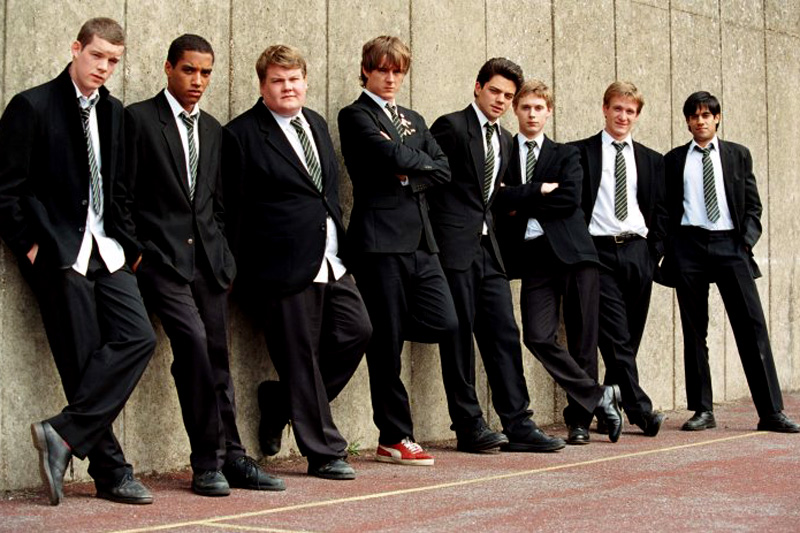
And it's awfully good ensemble acting. It'd be a bit odd if these boys don't turn out to be the next generation of Jude Laws and Clive Owens.
Saturday, November 04, 2006
I Get It
It's kind of amazing that it took me this long to get it. Just because I happened to go to a performance of "A Midsummer Night's Dream" last night, I finally realized that "Shortbus" is sort of a version of the "Dream." The "Dream" has built into the plot the elements of dream, magic, and fantasy that prevent most viewers from retreating into the default stance of literalism, but somehow a lot of viewers haven't gotten that about "Shortbus" and come away imagining that it advocates occasionally switching sexual partners as a solution to depression, insecurity, anomie, and the meaninglessness of life--not that that's such a bad idea, really. Well, yes, it does, to the same extent that the "dream" counsels running away from your parents into the woods and getting involved with a lot of fairies.
Monday, June 12, 2006
The reason A Prairie Home Companion works so well for its subject, the reason it's an unusual movie, the reason it's a typical Altman movie, and the reason critics have been more or less condescendingly calling it endearing rather than just recognizing that it's a really good movie, all come down to the stranglehold the standard three-act structure has on American movies. While most movies derive from Ibsen, Altman's derive from Chekhov; not only are their plots and characters diffuse, but they have that same seriocomic spirit and unfamiliar acceptance of everything that make Chekhov popular with actors and a little scary for most audiences. No matter how big the project, Altman's movies are always modest in aim; he's never wanted to make a great movie featuring great performances that will knock everyone's socks off, and that makes him very hard for film reviewers to really get. They treat him like an eccentric uncle because they don't get that the rejection of greatness is a pretty great thing.
John C. Reilly has such a beautiful voice you have to wish somebody'd write him a musical.
The Faculty Room, at Wolly Mammoth, is not great and does not work. There's sort of an amusing bit in it in which a sock-puppet Holden Caulfield has a dialogue with an English teacher and, eventually, a sock-puppet J. D. Salinger. The thing is, it only reminds one that Holden is right: most people are phonies, and that sucks, and people really ought to try to make some kind of commitment to being truer to who they really are. The Faculty Room seems phony because everything in it seems contrived to have its effect, including the invocation of the popularity of the Left Behind books. It's evident that the play is trying to use the Rapture in the way Angels in America used angels, but it comes off as just a device to make something happen. The central line of the drama futzes around on the topic of teachers sleeping with students, but it just makes the appeal to conventional morality seem squalid and unimaginative.
This week I've got to finish a conference presentation on The 5000 Fingers of Dr. T to give in Massachusetts next week and I'm way behind. I'd like this to be the core of an article or even book I've had in mind for at least five years. I'll also be working on stuff for the dreams and education book. After the conference Art and I will be in Provincetown for a week, so it'll be July 4 before I'm back and trying to get back on a writing schedule. When I get a chance I'm going to write some on what I learned by doing the Sex and Cinema course this summer; I want to throw together a couple of book proposals and see if I can get a project going (on dreams); and I've got fall preparation to do. But i'm hoping to get back to some other writing in July and August.
Thursday, April 20, 2006

The Latest on Sex in Cinema
So once again, I'm figuring out how to fit this into 12 sessions, but I'm trying to articulate some principles--not only movies I think are cool, but following a theme. I'd been thinking the idea here is Conformity and Repression, Rebellion and Subversion. Sometimes the best theses are sort of obvious, and it seems to me it makes sense to emphasize how American representations of sex, in popular culture and in politics, are founded in essentially puritan notioons of orginial sin. New populations, new media, new artforms, new belief systems arise, but that is the currency they deal in, so they adapt only in terms that fail to escape the prevailing ways of framing the cultural questions around sex.
Now, I like this approach because it gets at what's American about American movies' ideas about sex; because it allows us to focus on sexual behavior and how it's represented, instead of taking sexuality as a mere instance of gender identity and relations; because it allows me to ground the course in a few basic instances I particularly like, especially Bill Condon's film Kinsey (along with the cultural politics of serious biological, sociological or historical study of sex) and Michael Warner's book The Trouble with Normal; because it puts the hetero/homo division, along with fetishisms and paraphilia and the whole question of what Americans do and don't consider sex, consider racy, and really enjoy and fear in representations of sex, in a more interesting light than either politics or Freudian views; because it sets me up personally to come back later and discuss the garden-of-Eden fantasy in relation to Melanie Klein's ideas about sex and aggression; because it seems to me to place issues of genre and sexuality in an interesting light (as with film noir, horror, and farce especially); because it gives me some kind of ground for distinguishing between the commercial cinema, porno and the adult film industry, and avant-garde and experimental film, on a kind of ideological as well as purely descriptive basis; and because I think it provides the ground for interesting choices in readings.
So that is kind of where I am today, and it leaves me choosing from among the following films, I think
Introduction to the course:
Kinsey with Sex Ed Videos from the 1950s, with excerpts from The Subject is Sex, Heavy Petting, Everything You Always Wanted to Know About Sex
If I decide to cover the early establishment of sexual themes in melodrama in silent film it might be with
Broken Blossoms, Our Modern Maidens
To establish the difference between American and European representations of sex:
Pandora's Box
For the importance of star persona and celebrity:Marlene Dietrich (Blonde Venus), Mae West, Marilyn Monroe
I want to do something on the erotics of the musical: The Gang’s All Here, with Busby Berkeley numbers, and the documentary on Carmen Miranda, Bananas is My Business. This covers star persona and exoticism of culture and race as well.
For melodrama on the theme of repression in "middle America": All That Heaven Allows (women and children)
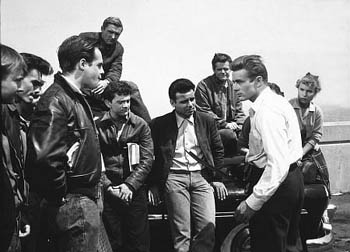
Rebel Without a Cause (teens, homoeroticism, "homosociality" and triangles)
Blue Velvet
For farce on the same theme:
The Miracle of Morgan’s Creek
Pillow Talk, The Thrill of It All, or Man’s Favorite Sport
Back to the Future (great Oedipal stuff there, a good place to cover Freud)
On sex and power:
The Apartment, Secretary, Some Like It Hot (as well as Sunset Blvd.)
On the film noir "myth" of repression, erotics, and violence:
Postman Always Rings Twice, Double Indemnity, Sunset Blvd.
Duel in the Sun / Lust in the Dust, Invasion of the Body Snatchers, Carrie, Psycho, Bonnie and Clyde, Scream (as pastiche)
Boys Don't Cry (with The Brandon Teena Story)
The "erotic thriller":Basic Instinct
How homoerotics is represented:
Top Gun, The Gay Deceivers, The Celluloid Closet, Poison, Postcards from America
Porno: Inside Deep Throat, with some interviews with Adult Stars and early porn; Pornography: The Secret History of Civilisation (British documentary)
Avant-garde: Trash, Curt McDowell shorts, Thundercrack!, Blow Job, Sins of the Fleshapoids, Scorpio Rising, Flaming Creatures, A Dirty Shame. I'm surprised and pleased at how much stuff I've got on this topic, so I want to do it right.
To establish differences between American and other ways of representing sex, I'm thinking about: The Dreamers, Last Tango in Paris, Belle de Jour, and Happy Together, but especially thinking of showing Y tu mama tambien or Law of Desire.
Some of these are pretty indispensable to me; the others I need a couple more weeks to mull over. I'm working on the readings now, and in some instances I may choose a film on the basis of whether I can find a good reading to go with it. I'm still thinking these over as possible required texts:
Warner, Michael. The Trouble with Normal
D’Emilio, John, and Estelle B. Freedman. Intimate Matters : A History of Sexuality in America
Dyer, Richard. Stars. McNair, Brian. Mediated Sex : Pornography and Postmodern Culture.
Money, John. Gay, Straight, and In-Between: The Sexology of Erotic Orientation
Poulson-Bryant, Scott. Hung : A Meditation on the Measure of Black Men in America.
There really isn't a reasonably short introduction to the critical study of film I can throw in, or I would. I have a lot of essays collected for reserve readings. That's it for now.
Saturday, February 25, 2006
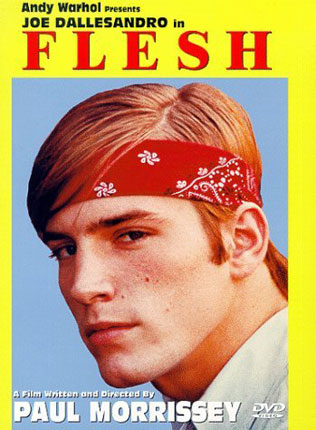
So I'm going to be teaching this course on Sex in American Cinema at St. Mary's for three weeks in May. There's already buzz and apparently all but a guarantee of high enrollment. Now I have to figure out what approach to take, and what to include.
All I know so far is I don't want to do this as a run-down of standard contemporary gender theory, but instead try to apply actual empirical, scientific, and social study of sex and sexual behavior to understanding films, their depiction of sexual relations and relationships, and their impact on ideas and behavior. I guess what I'm looking to break out of is the unconsciously puritannical strain that relentlessly seeks to substitute the social for the actually sexual in all studies of sexuality in art and culture. In the back of my head I suppose I'm also looking at it as a way to test my problem with Freudianism--the primary notion that cultural productions start with a sexual impulse, the basic concept of libido. (A lot of post-Freudians are more sophisticated than that, but still retain the basic assumption in the structure of their theory.)
This is the course description I gave them:
Cinema and sexual life have evolved together in the United States for a hundred years, and it’s impossible to say which has led and which has followed. From early instances of the screen star as sexual ideal in the 1920s, through the effect of drive-ins on sexual activity among teenagers in the 1950s, to the contemporary depiction of gay characters and love affairs, the movies have not only reflected Americans’ attitudes about sexuality but actively taught us what to believe, denounce, and accept. Gender roles and sexual relations are so central to narrative cinema that in a real sense the history of American cinema is the history of sex in America. To comprehend this subject, we will study both the social issues that have affected sexual behavior in America and the essential strategies in film studies that help us understand how films communicate ideas. Selected topics: Comedy and Courtship; Melodrama and the Power of Female Sexuality; Star Image and Sexual Scandal; Metaphors of Sex in Film Genres (Film Noir, Horror, Science Fiction); The Adult Video Industry; Race as Sexuality; Sex and Violence; Sexuality as Subversion.
I'll probably add a couple of topics to that. I'm interested to see if I can find a way to present hetero- and homosexuality as complementary instead of mutually exclusive; and to discuss non-sexual same-sex relations, because that area is so confused; and I want to get into the cultural creation of the teen-ager as a sexual category. Also, maybe, the not-so-subtle paradox underlying the defense-of-marriage debate. The clearest way I can put this, I think, is: What we often hear is that the opposition is about defining what marriage is for as a social contract: Marriage must be defended from dilution of its purpose of channeling reproduction (and thus sexual behavior) for society vs. marriage is essentially a monogamous affectional bond that can serve society. What this occludes is that marriage is being presented both as the acme of sex and where sex goes to die. That paradox, which may be a way the culture finds of expressing an important truth about both sex and society, is actually more interesting than the opposition the society creates in order to promote two equally unrealistic and counter-productive political positions. (At this point, promoting gay marriage has gotten as boring as fighting against it, though still not as criminally stupid.) That may also help get to the special position that the '50s seem to occupy in Americans' view of cultural representations of sex--which may just be a matter of the social power of the baby boomers. (That kind of thinking--the '50s as a state of mind rather than an historical period--is the kind of sloppy but pretentious thinking that might absolve me of the responsibility to offer any serious chronological study of cinema or of sexual behavior.) Anyway, it ought to a good place to explore the idea that cinematic representation by its nature has a dialectical relationship with the realities of the society, which is probably the idea that matters to me most, as a way of shifting the emphasis in the wrong-headed ways I think people use to look at art.
I am only just starting to think about what I might have them read. My initial search for stuff specifically on cinema and sex has been disappointing because the stuff has been dogmatic and not really about sex at all, quite often. I know I'd like to use The Trouble with Normal, because it sets out the issues about cultural attitudes so nicely, just as I know I want to start with the film Kinsey, because it helps define America's troubled relation with both sexual behavior and the representation of sexuality. (The very fact that a lot of people who talk about sex in cinema fail to start with this distinction indicates the problem I have finding stuff that will halp set the terms I want to use.)
But what do you care? You're wondering what movies I'm thinking of using. This is my A list:All That Heaven Allows
Basic Instinct
Bonnie and Clyde
Boys Don’t Cry (with The Brandon Teena story)
Broken Blossoms
Chinatown
Duel in the Sun
Inside Deep Throat (with Rated X – A Journey Through Porn)
Kinsey
The Lady Eve
Mandingo
Mildred Pierce
The Miracle of Morgan’s Creek
The Opposite of Sex
Pillow Talk
Play Misty for Me
Poison
Postcards from America
The Postman Always Rings Twice
Rosemary's Baby
Show Girls
Some Like It Hot
The Terminator (with Back to the Future – Oedipus)
Top Gun
Trash, Flesh, or Heat
Y tu mama tambien
Your Friends and Neighbors
I can only fit in 10-12, even if I squeeze in a couple of double features. My B list:
40-Year-Old Virgin
A Dirty Shame
A History of Violence
American Beauty
American Pie
Before Night Falls
Before Sunrise
Blue Velvet
Bob & Carol & Ted & Alice
Boogie Nights
Carnal Knowledge
Closer
Double Indemnity
Eternal Sunshine
Far from Heaven
Fast Times at Ridgemont High
Faster, Pussycat! Kill! . . . Kill!
Friday the 13th (or one of the series)
Gilda
Happiness
Happy Endings
His Girl Friday
It Happened One Night
L.I.E.
Lust in the Dust
Me and You and Everyone We Know
Midnight Cowboy
Mysterious Skin
Porky’s
Primary Colors
Psycho
Rear Window
Red River
Risky Business
Rope
Salo
Scream
Send Me No Flowers
Sex, Lies and Videotape
Shadow of a Doubt
She’s Gotta Have It
Stagecoach
The Basketball Diaries
The Butterfly Effect
The Doom Generation
The Dreamers
The Fluffer
The Idiots
The Road to Bali
The Thrill of It All
Thundercrack!
Velvet Goldmine
Vertigo
Wag the Dog
I just found a compilation of '50s-era sex-ed films on eBay which should be a great addition. The reason I'm thinking of a few foreign films is by way of contrast, to establish the conventions of American film, but also to go into how "exotic" came to mean "sexy"--just as "explicit" means "filthy" now.
By the way, my search for films for this course on imdb.com led me to I'm a Dirty Filthy Cocksucking Cunt! Why is it all the good titles are taken?
Now I'm going to get to work on what to read.
The rest of the time right now I'm focusing on course preparation, the talk I have to give on Whitman's "The Sleepers" at a conference in March, and the work I'm supposed to be doing for a book on dreams and education I'm working on with Kelly Bulkeley and Phil King from the International Association for the Study of Dreams. Gary Kornblau has something in store for me but I don't have time to get started on it yet.
Friday, January 20, 2006

I've been in Canada; I've been putting my spring classes together; I've been sick. When I get it together, I'm going to start writing a bit here about my plans for a Sex in American Cinema course at St. Mary's College in May. Meanwhile, I don't have to say anything at all about Brokeback Mountain, because Mark Simpson, who is as practically perfect as his compatriot Mary Poppins, has said it all already. Mark Simpson invented the term "metrosexual" and here he outdoes it with "retrosexual" (yum) and "fauxmosexual" (and you know who you are). At first it may appear that he's just complaining that we don't see Jake and Heath doing it--and he has every right to complain, God knows--but instead, he is, as he often does, pointing out the obvious that everyone ignores: Brokeback Mountain is about acceptable styles of masculinity, and avoids its ostensible subject of sex almost completely.
I love Mark.
By the way, the image of Brokeback recast comes from a Chinese website, and I have no idea what the context is. But I find I get kind of a charge out of it.
LONESOME METRO-COWBOYS
By Mark Simpson
Is there a support group for people who didn't like BROKEBACK MOUNTAIN? We must, if the rave reviews and newspaper reports are to be believed, be a very tiny - not to mention vulnerable - minority. Am I dead inside because I didn't experience the torrent of emotions I've been reading about in newspapers and in movie forums? Am I as emotionally crippled as Ennis because I didn't blub and hug after sitting through this `visceral' movie, but instead wanted to go and `help with the round up'? Am I suffering from internalized homophobia?
Probably all of the above. But this doesn't mean that this film which has become a phenomenon, isn't as tedious, mawkish, lifeless, unconvincing and bizarrely hypocritical as I found it to be. I wish now that I'd left after the first 15 minutes with the two bored, gum-chewing teen girls in front of me at the multiplex and gone shopping with them for the latest Westlife album instead. There would at least have been more sex.
OK, so there's a hurried joyless near-rape in the dark at the beginning, but we've seen all that before in more detail in prison movie films like SHAWSHANK REDEMPTION. Although true to Annie Proulx's original short story, this, the only sex scene in this `love movie' seems to owe more to director Ang Lee's awkwardness and impatience about MANSEX than Ennis'. This filmic essay on homophobia and its terrible toll goes out of its way to shield us from what it is that these two men have together or what it is that they do when together - or why they would bother to go to the trouble of trying to relive it every year for decades. Across thousands of miles.
Even when they kiss, it's carefully shot so that we never really see them kiss, the shadows in the tepee artfully falls across their mouths, or if somewhere better lit they appear just to be pushing their faces together, lips and teeth gritted. This makes the scene in which Ennis' wife spies these desperately `closeted' guys `kissing' outside her home all the more unconvincing and ironic. The realisation suddenly hits her: `Omigod! My husband is a fauxmosexual!' No wonder she's distressed.
Their boss also clocks the lover boys from a distance. But why their boss would assume they were queer because they liked to wrestle with their tops off rather than wannabe Abercrombie and Fitch models I don't know; maybe he had special binoculars. But I have to say that I sat right at the front of the theatre and I'm still not really sure what the hell they get up to on Brokeback Mountain. They don't talk much. They don't shag. They don't kiss properly. As Ennis' wife complains, `You go fishing but you don't bring back any fish.' The film tells us they're lovers. Insists that they're lovers, goddammit. But fails utterly to show it.
Perhaps I'm merely a jaded homosexual. Perhaps I've seen too much. Perhaps it's absurd of me to expect a proper snog between the lovers in a `love film', especially in a film that is telling us over and over again in painfully didactic fashion how bad homophobia is and a film which has been trumpeted for it's `courage'. But in the small provincial town in England's equivalent of Wyoming where I now live, I've several times seen (or rather stared at) drunken young soldiers snogging one another, `for a laugh', tongues and everything, in the middle of crowded pubs, much more convincingly, passionately and lingeringly than these actors who have been told by a thousand interviewers how `brave' and `committed' they were to do these scenes.
But then, there's not much realistic about this film. Even the impassively beautiful Wyoming countryside seems to have been wrapped in cellophane and Brokeback Mountain a big ribbon bow stuck on top of it. The boys are also very appetising, but while Heath Ledger turns in a fine performance with an almost impossible script and bloodless directing, both of them are too pretty - Jake Gyllenhaal in particular, lovely as he is, looks too metropolitan, too confected, too DETAILS fashion-shoot with a Western theme. By the time he reaches the 70s he looks he like the cowboy out of the Village People: the same haircut, the same black moustache, the same Stetson. But maybe this shouldn't be so surprising since the cowboy from the Village People, I discovered later, was the `gay cowboy consultant' on this metro-cowboy movie; very Queer Eye For The Western Guy. (Personally, I wished they'd hired Nancy Walker, director of CAN'T STOP THE MUSIC in place of Ang Lee).
BROKEBACK is not a serious exploration of rural retrosexuality and its discontents, and certainly not a love story, but rather it's feature-length propaganda for contemporary, metropolitan metrosexuality. It is an attack on retrosexual repression in general and old-style, `outmoded' stoic masculinity in particular. This is the real reason for its tremendous, zeitgeisty popularity.
Both cowboys, Ennis in particular, are prisoners of their problems with expressing feelings: homophobia, internal and external, is just the biggest symbol of this. Their fat bald boss is an unfeeling bigot. Ennis' father took him to see the castrated corpse of a local queer when he was a small boy (`for all I know he mighta done it himself'). Jack's abusive father is uptight, cold and resentful. His father-in-law is a bullying buffon (who turns out to be a coward for good measure).
None of the older males in this film are fully human - because they aren't in touch with their feelings. They are all twisted, mean and nasty. Jack and Ennis, a product of that world, are stunted too; they're just not so mean and nasty. This is why they are also the only attractive males in Wyoming. Their desirability is proof to a modern, metrosexual audience of their sympathy, of their goodness, of their modernity, of the awfulness of their retrosexual predicament.
Because retrosexuality rather than homophobia per se is the real target of this film's didacticism, the emotional hobbling is hetero as well as homo. Ennis is portrayed as someone who is not just closeted about his passion for Jack but closeted in all his relationships. Whenever confronted with the need for a commitment or a demonstration of love, either for Jack, his wife, his daughter, his new girlfriend after his wife divorces him, he starts mumbling `ahh don't know. roundup is comin.'. Fear and loathing of homosexuality, of male emotionality and sensuality, of explicit tenderness between men is presented as a continuum.
Which, to some degree, it is. As the `father' of the metrosexual, I have some sympathy with some of the ideology behind this film, if not the execution. And at least in BROKEBACK male sensuality, aestheticism and homoerotics is not displaced into flip-flops and facials and appropriation of stereotypically effeminate homosexual traits as it was in the spayed marketing version of metrosexuality - even if it is somewhat fetishized here into jeans and carefully beat-up pick-up trucks.
But dress it up purdy or plain, or call it by any other name, like the marketing version of metrosexuality that preceded it, BROKEBACK is nevertheless also an accessorisation of homosexuality. This is effectively a film about two straight men who have a homosexual love-affair. After all, the two protagonists are married, the actors who play them are straight, as is the director, the author of the short story it's based on, and the vast majority of the audience. Even the sex is `straight' - there's rather more hetero sex than homo. BROKEBACK is literally acting out the culture's current fascination with homoerotics and male sensuality. Which, in itself, is no bad thing. Homoerotics and male sensuality are not the unique property of homosexuals. In fact, they make up a small fraction of those human beings who are affected by these things.
And yes, the reticence of the film in regard to actually showing Jack and Ennis' love for one another, either sexually or in any other way, and its generally unconvincing air, may not be entirely down to Hollywood's nervousness or hypocrisy. If their love for one another is merely symbolic, to actually show it instead of just asserting it might diminish its metrosexual message.
But what makes a film a cultural phenomenon doesn't necessarily make it any good. For me BROKEBACK's metro-cowboy propaganda is right smack dab in the place where it's supposed to have a big bleeding heart and is the very thing which makes it so disappointing. The ultimate irony is that BROKEBACK the `breakthrough' movie depicts less credible warmth, intimacy and tenderness between the male lovers than a movie like say, BUTCH CASSIDY AND THE SUNDANCE KID. Now nearly forty years old.
Palpably BROKEBACK is not the movie that people seem to want it to be - but it is a movie which, in it's vagueness, ellipsis and coyness, and even its hypocrisy, allows itself to be misrecognised as the modern explicitly male romance movie people clearly need it to be. Let's hope that its success means that someone out there can now make a movie that is a little more convincing.
Or even just one in which men in love kiss with their mouths open.
Copyright Mark Simpson 2006Mark Simpson's SAINT MORRISSEY has just been published in hardback by Simon & Schuster.
Tuesday, November 08, 2005
 Dreyer, Vampyr
I've been considering proposing a course on The Uncanny in Film and Lit. Unfortunately, I don't have time right now to go into why I'm feeling "The Uncanny" helps me to get at something I couldn't do with a course on Horror or The Gothic, but it basically comes down to seeing The Uncanny as an issue in representation rather than underlying beliefs--that is, the supernatural premise or incident is treated as defining subject matter and context for conventions in an analysis of the Gothic novel or the horror film, but I want to get instead at the creation of the sensation of the uncanny (and the conventions and premises, etc.) through the limitations and possibilities of representation, in narrative fiction and film. (Admittedly, this what a lot of theory-heads would do anyway, but I would be happier starting things out rightside-up by turning the conventional assumptions about the relation between reality and representation in art upside-down to begin with--that is, to admit, that supernatural belief is a function of narrative rather than assuming that narrative conveys supernatural belief.)
One reason I know this would be interesting for me to do is that the list of texts comes so easily:
Fiction
E. T. A. Hoffman
Keats - the gothic poerms
Poe (M. Valdemar, The Black Cat, The Tale-Tale Heart, Ligeia, William Wilson, a lot of others, really)
Washington Irving - The Stranger with a Bag, maybe Sleepy Hollow
Hogg - Private Memoirs and Confessions
Eliot - The Lifted Veil
Potocki - The Manuscript Found at Saragossa
Dostoevsky - The Double
Melville - Bartleby?
James - The Turn of the Screw, The Friends of the Friends
Dracula (esp. the uncanniness created by multiple and partial views)
Stevenson - Dr. Jekyll and Mr. Hyde
M. R. James, E. F. Benson
Six Characters in Search of an Author
Kafka - In the Penal Colony
Borges, Calvino
Shirley Jackson, Muriel Spark
Dick - Ubik, The Man in the High Castle
Peter Straub - Ghost Story
This leaves out, among other things, excerpting Montaigne, Thomas Browne, Robert Burton on considering the uncanny; and probably some orientation to the influence of Macbeth, Romeo and Juliet, and Hamlet on the Romantics' sense of the Uncanny. It'd be nice to find something in Hazlitt and DeQuincey.
Film
The Golem
The Student of Prague
Vampyr
The Dybbuk
Cat People
The Uninvited
Ugetsu
Rashomon
Kwaidan
Vertigo
Psycho
The Innocents
Invasion of the Body Snatchers
Les diaboliques
Rosemary's Baby
Total Recall
And in art generally, there'd be Goya, Fuseli, the Pre-Raphaelites, Surrealism, the Chapmans, Tony Oursler . . .
Key issues: This'd let me go into:
Anomalous psychological experience
Threats to identity
Dead/Alive
Real/Unreal
Doubles
Mulitiplicity of view, subjectivity, transcendentalism
Metaphysical paradox
Self-reference and Romantic irony
Gender and sexuality
I wouldn't base it on Freud, but a psychoanalytic view especially with a lot of Klein (reparation as haunting) would be good. Todorov. Mary Douglas probably has something relevant, too; structuralism is a very good approach for establishing the Uncanny.
I'd be very happy to have the chance to go into this while thinking about some of the films (I've never written up my talk on The Dybbuk for an article) and working on the Double novel.
Tuesday, November 01, 2005
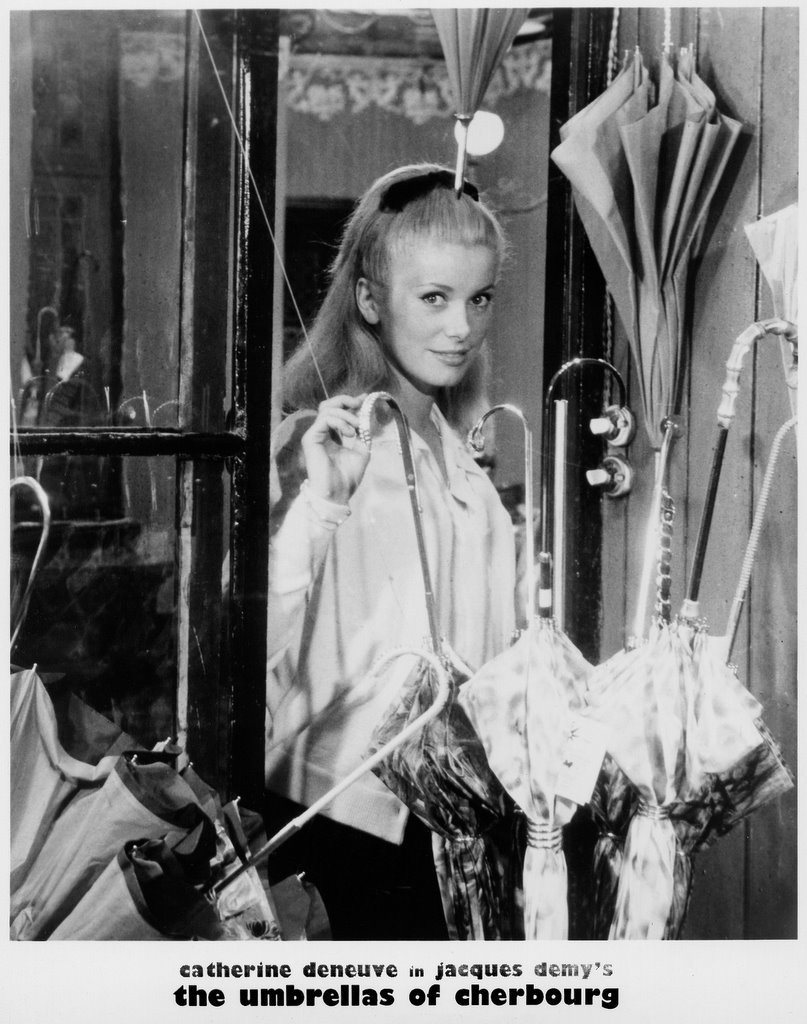

And Then There's The Umbrellas of Cherbourg
which has a weird sort of hidden relationship to The Threepenny Opera, which, when you think of it, is kind of inevitable--how many models are there for a really interesting 20th-century opera, self-consciously aware of its relation to the past? The relationship is coded into the musical score by Michel Legrand, which, I've always thought, has several moments that are precise transformations of The Threepenny Opera (which is also true of the American film version of Pennies from Heaven and of Stephen Sondheim's Sweeney Todd). But in The Umbrellas of Cherbourg, the irony swings the other way. The Threepenny Opera seems like a black-and-white film even when it's performed live on stage; The Umbrellas of Cherbourg is more "about" color than maybe any film outside of Paradjanov. The Threepenny Opera is one of the few entirely successful examples of political art in the twentieth century; The Umbrellas of Cherbourg is a self-consuming artifact of the growth of cinematic connoisseurship. It goes to the other extreme, but it works. I never quite understand people who say they don't get it. Maybe they expect it to be something other than it is. I wouldn't trade a good Douglas Sirk movie for it, but it's still great in the same way.
Subscribe to:
Posts (Atom)


 Posts