Showing posts with label dreaming. Show all posts

Friday, May 25, 2007

Ellenberger

Henri Ellenberger, The Discovery of the Unconscious
53-74 Gassner and Mesmer. Enlightenment rationalism emerging in challenge to Gassner's "preternaturalist" explanation of "possession"; Mesmer's "rational"explanation of "animal magnetism." Mesmer's obscure involvement in politics 1785-1815. The notion that slave rebellion and thus Haitian independence were inspired by a mesmeric fad.
(Curiously, I dreamt of Haiti last night before reading about this this morning:
I am sitting in on a class at the Corcoran. The instructor doesn't know I'm also an instructor, and I'm appalled by her behavior: She keeps the class waiting while she finishes a personal phone during class time; she seems unsure and unconcerned about requirements and due dates; she seems to have a superficial grasp of her subject. Cory Hixson, Bob Devers, and Richard Wilkerson are sitting there, too, and all sort of acknowledge this isn't good but also "what can you do?" The instructor switches on a television for us to watch a video. On the screen I see a report about poverty, hunger, and political unrest in Haiti. There is an image of a kind of sculpture: a wooden board that has a largish metal bomb mounted on it pointing downwards, a bullet-shaped bomb with a tail, like a cartoon bomb dropped by a plane, very rusty, surmounted by a smaller bomb of the same shape, also pointing downwards. Mounted above the bomb are some leaves and vines, other things like twine, making a pattern that suggests a loincloth, like the bombs represent a cache-sexe holding a very large penis. The title is "Il met son front sur le fronton," and I understand that this means that the sculpture is a daring political joke about the military dictator, who has a phallic idea of power.
BTW, I immediately associate the loincloth with watching Walkabout last night, and the dictator (partly through the leaves and vines) with Bush, and my feeling that he is all balls, all nerve, with nothing else to back it up.
After I wake up, I don't know what the French phrase means. I have to look it up to get the sense it could mean "He puts his face (forehead) on a monument."
77-101 German Romantics - Clemens Brentano's book of the visions of Katharina Emmerich - The Seeress of Prevorst (von Eschenmayer?) - Kerner's inkblots (which could be a key precursor of the uncanny use of photography) - spiritualism - Bernheim against Charcot
Chapter 3 110-174 Multiple personalities, doubles (dipsychism)
Chapter 4 The philosophical and ideological background

The point of this is to depict the growth of cinema and psychoanalysis not just as coincident and changing the cultural conception and place of images in similar and related ways, but to see both as growing out of changing assumptions in the previous centuries--about the nature of perception, imagination, ansd representation--and particularly to emphasize the contribution of "fringe" phenomena - hypnotism, spiritualism, secret societies, esoteric knowledge, the faddish ideas both Freud and Jung took up - as a kind of popular avant-garde in signifying and even bring about change.
(It's just because of the failure to recognize the significance of such movements that liberal democrats and academics failed to understand the power of Christian fundamentalism, or that a fathead like Fukuyama was able to declare history done with even as Islamic fundamentalism was gathering momentum. The issue is a continuing profound inability to appreciate the role of the irrational in political and cultural life, and thus to understand cultural change in terms of the role of the unconscious. What is usually done is [still] hand-wringing over reason confronting unreason, as if one side were more reasonable than the other, as if one side was not subject to unconscious motivation, as if [with Freud] the id could be replaced by ego.)
As with politics and culture generally, a real appreciation of the unconscious changes understanding of the nature of cinema fundamentally, and not according to the specious models of Metz, Baudry, or Eberwein.

Wednesday, May 16, 2007

What I Do All Day, It Seems

From the IASD group on Dreams, Creativity and the Arts:

I mostly haven't answered on this stuff, because I'm not sure what Juan is asking about. I have a feeling that this has something to do with the fact that Juan is asking a question from the standpoint of critical scholarship on the analysis of film, while most of the users of this list are practicing artists. If critical theory bores you, p l e a s e skip this message.
Another issue may be that Juan is, I think, in South America, where the critical discourse in humanities scholarship has a very powerful influence from Lacan, whereas in the United States, while that influence has been very significant in film theory, it has also much abated in recent years. I also hesitate to start recommending books etc. when I have no idea whether Juan is already thoroughly familiar with them. I can't tell whether he is starting out in this topic or already steeped in it.
Juan speaks of the interpretations of psychoanalysts, and that can mean a lot of things. I suspect he means the interpretations offered by psychoanalytically-oriented critics of fictional dreams in artworks, and of the artworks themselves as wholes. In South America particularly, these are likely to be the statements of Lacanians, which may be very different from what a traditional Freudian would say--and on top of that there's the fact that it is entirely legitimate and may even be clarifying to refer to Jungians and objects-relations therapists as "psychoanalysts," as it is not a proprietary term.
As for actual psychoanalysts' interpretations of actual dreams, most of us simply have no experience of them at all--very few people inthe United States see a psychoanalyst, and you are much more likely to encounter a Jungian than a Freudian, and almost never encounter a Lacanian, whereas there are many Lacanians in practice in Central and South America. I wonder if what Juan means by psychoanalytic interpretations, then, are those offered in books, and especially by Freud himself. I have been considering the relation between psychoanalytic theory, dreaming, and film for a long time now, and I have almost never encountered anyone who uses, or feels content with, the projection of any orthodox psychoanalytic theory on to real people's actual dreams. I think there is a consensus among therapists in the US that into the 1960s, the use of dreams in classic Freudian therapy was a means to convert the analysand to the Freudian system rather than a helpful means of addressing the analysand's issues, and thus dream analysis was to a large extent abandoned in actual psychoanalytic practice.
The use of psychoanalytic theory as a tool to explore a fictional dream--as Juan says, either a dream sequence, or an entire film or novel that structures or portrays itself as a dream--is almost always, in something like the same way, simply a use of the artwork as rhetorical support (illegitimately, pretty obviously) for a concept in psychoanalytic theory. A good example is Zizek's use of Hitchcock movies to make a claim for Lacan's theories; I'm not sure even Zizek would insist that they teach us something about the films and how they work, as opposed to making clever illustrations of theoretical points which are actually about the culture that produces and consumes films, rather than the films themselves.
Again, I'm only guessing and I'm not sure what he is asking about, but academic film theory in the United States, Europe, and I suspect elsewhere, has been very much influenced by two authors, Christian Metz and Jean-Louis Baudry, who take a very narrowly Freudian/Lacanian approach to art. What is interesting is that they do not offer "interpretations" of fictional dreams, or films, at all; they offer a whole view of cinema that is based on Freud's dream theory. I'm kind of partisan about this, but I certainly think many, many film theorists would agree with me: the application of Freud's theory of dreams to art has been very misguided, and Metz and Baudry, though influential, are just wrong in a variety of ways. (For example, they are mistaken about the empirically verifiable responses cinema audiences have to being in a darkened theater--as Freud is mistaken about patterns of dreaming.) The classic objections to Metz and Baudry are in Noel Carroll's book, Mystifying Movies. Another book very much influenced by them is Roger Eberwein's Film and the Dream Screen, a fascinating curiosity which summarizes a lot of psychoanalytic theory about film, and which I also happen to think is very mistaken. I emphasize though that Eberwein does not offer "interpretations" of either dreams or films; he writes about the phenomenon of cinema.
My feeling is that Juan wants to explore further the phenomenology of dreams, but I am not sure what exactly, in his view, this has to do with the phenomenology of cinema. For what is "dreamlike" in cinema, generally, the first classic statement was by Suzanne Langer in "Feeling and Form," but it's pretty rudimentary. Filmmakers like Maya Deren and Stan Brakhage have written about how their work tries to approximate or learn from the dream state; Parker Tyler's writings on experimental cinema are very smart about the same topic. Gaston Bachelard's book, "The Poetics of Reverie," is a good guide; as is, as Richard W. might have mentioned, Bert States' book, The Rhetoric of Dreams. (Richard, by the way, put together a formidable introduction to a lot of relevant matters at the Postmodern Dreaming site.) I think Gestalt psychology and object-relations theory still have a whole lot to teach us about what happens when we experience a film and enter a state much like dreaming, reverie, or fantasy (and understanding this better might undermine a tremendous amount of sloppy politically or morally-oriented criticism). I do not know ifJuan has mentioned or is familiar with Medard Boss and existential psychiatry's view of dreaming; George Devereux kind of applies it toGreek tragedy in "Dreams and Greek Tragedy," and more centrally, Ludwig Binswanger does in "Dream and Existence." Finally, Michel Foucault's introduction to Binswanger, "Dream, Imagination, andExistence," is something I think Juan would enjoy if he's not already thoroughly familar with it. I apologize if I am rehearsing material that is already familiar.
By the way: I also think Wittgenstein's criticism of Freud's theory is very much to the point, and his general comments on Freud are witty and insightful. Interestingly, Jung's criticisms of Freud are very similar to Wittgenstein's. I think people may overlook this because they do not expect Jung to so rational.
And I think Mario Levrero has not been translated into English.
Bernard

Saturday, May 05, 2007

Winsor McCay


We decided this morning to shift some sessions around at the IASD conference in Sonoma in June and I won't do the paper on Dead of Night, etc. after all, though it's still the basic idea for a chapter in a book, and I might do it in Lincoln UK in September. Instead we're moving my Winsor McCay talk into that session. I don't think I posted my proposal for it here:


Winsor McCay: An American Artist in Slumberland

Winsor McCay (1867-1934) created not one but two of the most influential of all instances of dream art: Dreams of the Rarebit Fiend and Little Nemo in Slumberland, which ran concurrently in American newspapers from approximately 1903 to 1914. Their astonishing and often radically anti-authoritarian celebration of the bizarre and grotesque, barely masking violent and sexual material beneath the surface, reflects the same cultural concerns we see in the contemporary rise of psychoanalysis and rapid growth of cinema as a popular art form. In this presentation, participants will analyze and discuss selected McCay strips to isolate the key stylistic features and psychological concerns characteristic of McCay’s cartoons and thus of his distinctive stance as an under-recognized American artist. For this purpose, we’ll focus on Dreams of the Rarebit Fiend: each strip economically represents a single nightmare, so a dominant metaphor, anxiety, or theme may be identified in each one. On the basis of our analysis of these two influential strips, we’ll consider McCay’s early contributions to the American animated cartoon tradition, arguing one significant thesis: the comic cartoon tradition built on inspiration from McCay’s early work in taking mutability as its defining convention and metamorphosis as its outstanding trope. Although mutability of image seems an inherently available feature of animated drawing, the realist tradition rejected it, while cartoonists like Max Fleischer (Betty Boop) and Chuck Jones (Bugs Bunny) took up the example of McCay’s authentic dream aesthetic.

So what I'll work on in St. Mary's while teaching the class May 14-June 1 is the chapter I have to do for the book on dreams and education, the McCay talk, which I'll supplement with work at the LoC when I get back, and randomly revising old poems.

Sunday, April 15, 2007

The Dream Body of George W. Bush

This was written at the turn of this year and just published by Elizabeth van Fleet in Spot, a magazine she edited at St. Mary's College of Maryland.

I wake up—I wake up inside the dream, you understand—and I’m in my freshman dorm room, in my bed. It’s a narrow bunk bed; I couldn’t sit up without bumping my head. Sometimes when I got into it, it felt like I was climbing into my coffin. Anyway, I wake up—inside the dream—and my roommate, F---, is just standing there in the semi-dark, turned away from me, in his pajamas. My freshman roommate was a very dorky guy, who wore pajamas and picked his nose right in front of me. He turns slightly toward me and I can see he’s got a hunting knife, a big, scary-looking, slasher-movie kind of knife, like you’d gut a deer with.
Then he smiles down at me and he hasn’t got a knife in his hand anymore. He’s a got this unworldly big hardon tenting his jammies, like a fireplug, thicker than a guy’s dick could possibly be. He rubs it just a little, smiling. Then it’s like there’s a close-up of his face, or maybe he’s leaning in over me, and I see he’s got blood in his mouth, like his gums were bad or he bit his tongue or something, but he’s still smiling, and he’s turned into George W. Bush, like he looks in those pictures from his Texas Air National Guard service, grinning like he knows exactly what I’m thinking.

* * * *

My friend M--- and I are on an assembly line, in chef’s hats and smocks, like Lucy and Ethel, and there are candies coming by, we’re trying to roll them in chocolate but of course they’re coming too fast, so instead of freaking out like Lucy and Ethel in the show we just laugh and laugh like we’re stoned, and the guy in charge comes out like he does in the TV show, only it’s George W. Bush, and he looks at us in disgust. Then he reaches over and takes my friend’s chin, but gently, into his hand, and then he suddenly spits, hard, into my friend’s face, like a cobra spitting venom. And my friend’s head explodes. And then he turns to me and says, “Now you clean this mess up,” and leaves, and I start trying to clean up, and then the assembly line starts again and a coffin comes down the line and I have to drape an American flag over it and salute it as—the assembly line is like as long as a football field now—as it disappears out of sight.

* * * *

The night before my wedding two years ago, I had this strange dream: I’m back in the high-school locker room, and I’m stripping off my football uniform. There are a couple of other guys around doing the same. But beyond, I can see a very brightly lit white space, like a typical Chelsea art gallery, with people standing around. I recognize people I’ve seen on TV: Condoleeza Rice, Dick Cheney, Nancy Pelosi, Antonin Scalia. They’re all holding drinks and laughing. And then I see the guys and girls I knew in high school, the football players and cheerleaders, in typical Manhattan cater-waiter outfits, serving them.
For some reason, even though they can see me, I don’t mind at all walking past them completely naked, just carrying a towel, on my way to the shower. When I enter the shower room, the perspective gets all weird, like in Carrie: there’s only one guy there, but it’s like my field of vision has narrowed so he’s all I see, even though he’s all the way across the room from me. His back is turned, but I can see it’s an older guy, and I figure it’s the coach, who it always seemed to me, was in the showers more than he really ought to be. I mean, nobody thought there was anything funny actually going on, that I know of, but we knew that teachers weren’t really supposed to shower with students, and he always did. Anyway, I have this ominous feeling, like something’s going to happen that I’m going to have to deal with, to make a decision about, to act or fail to act.
I wash, he washes. And nothing happens. It’s not like I want something to happen, but I can’t believe I’m just standing here taking a shower with this guy when it feels like something’s supposed to happen. So finally I say, “Hey.” And the guy turns around. And it’s not the coach, it’s George W. Bush. He’s a lot shorter than I thought, really short, like 5’2”, though he’s got a dick on him like 6 inches soft, and his entire body is hairless, almost like a little boy with a huge cock on him. So he just nods at me, like, “How ya doin’?” and continues to wash. And I can’t stand not knowing what’s on his mind now, and I say, “Are you here for the party?” and he just looks at me, like, “Why would someone like me want to go to a party like that?” So I say, “I haven’t seen you here before. Do you teach here or something?” And again, he looks at me like why would I ask such a stupid question, only he seems more sorry for me than superior. Then I ask, “Are you here for the football game?” and he smiles kind of sadly and says to me, “To tell you the truth, I don’t really pay that much attention to sports.”

* * * *

I dream I’m Colin Powell and I’m standing at attention at some kind of ceremony, in my uniform. I’m saluting and there are flags and a lot of Marines in uniform; I think it’s a funeral at a military cemetery, or maybe a memorial service; I can see Washington-type monument buildings around. And there’s this weird little buzzing noise, really bothering me. It’s a voice, saying something; I can’t hear what it’s saying. I look to my right, and there’s no one standing there. Then I look down and it’s George W. Bush, only he’s the size of a kid, like three feet tall, and he’s got a tiny, buzzy little voice and he’s talking the whole time. I try to tell him quietly to simmer down, just hang on, be quiet while whatever it is is going on. But he starts plucking at my trouser leg, and then he’s pulling at it it, and he pulls my pants down and I get tangled on them and fall on the floor and he’s attacking me, digging into me with sharp fingernails, going for my face. And he’s still the size of a little kid and I’m still Colin Powell, by the way.

* * * *

I don’t know about this, this dream really shook me up. All it is, is we’re sitting in a rowboat, me and this old friend of mine, from home. I can feel the water rocking the boat gently, I can hear the insects and the birds and the fish occasionally breaking the water; I can see the sunlight filtered through low-hanging branches. And we’re fishing, you know, with poles, out of the boat. On the bank of the river, in the sunlight, I can see some guys playing touch football. They have their shirts off, and they look like those pictures you see in an Abercrombie & Fitch store, like they’re just pretending to play football, just pretending to have a good time. And somehow, my friend turns into George W. Bush; he’s looking quiet and intense, like he’s thinking all seriously about something, and then I notice that the base of the pole he’s using is rubbing against his crotch, he’s rubbing himself off against it, and suddenly I’m really anxious, I mean I’m pretty terrified, like what’s gonna happen here. And he doesn’t feel like my friend anymore, but different, like a grownup does, when you’re a kid. And Bush grins at me, but that don’t make me feel any better, and he reaches across me, like to get at the tackle box, but his hand grazes across my crotch, and when the side of his hand brushes across it, I feel that my dick is rock-hard, and that’s when I . . . I mean, if you’d a told me I’d wake up from a dream about George W. Bush with a fresh load in my jockeys, I just don’t know what.

* * * *

I go through this doorway in like an ancient pyramid with Lara Croft, Tomb Raider, guiding me, holding a torch. Before me is a mummy in one of those mummy-container things, and it opens slowly, you know, like in a movie, and standing there inside the thing is . . . Laura Bush. Her skin is like painted porcelain, and she seems as much like a statue as a person. She is beautiful but scary for some reason, and I draw back and look to Lara Croft for help. But now it isn’t Lara Croft there any more, it’s George W. Bush, and he’s wearing a long white Arab-type and one of those little white caps, like a fez, I guess. And then he says this weird thing: “Kneel. Kneel before the goddess of necessity.” He isn’t holding the torch any more, but the room is glowing with light and I realize that the light is coming from within him. I do kneel. “What am I supposed to know?” I ask, because I realize that I can learn a really big secret here. And he says, “When you come right down to it, it isn’t what you do that matters. It’s what you say.”

* * * *

I wake up in a cabin in the woods, and I hear noises, like someone rattling around in the kitchen. I walk down a hall, a carpeted hall, way too long and fancy to be in any cabin, and through a doorway I see that I’m looking into the Oval Office—in the White House, you know? The President is standing, turned away from me; it’s like there’s a stove at the window, and he’s cooking eggs and bacon or something, he’s wearing an apron and humming a little tune, like a TV sitcom theme song. He turns towards me—it’s George W. Bush—waves me over, scoops breakfast onto two plates, and sets them down. I come over and look at the plates and there’s a little dead dog on one and a little boy’s head on the other. And he’s smiling, smiling, and now he looks sort of more like Alfred E. Newman from Mad magazine.

* * * *

I get hired by this creepy old guy to be a male prostitute. I mean, I’ve never had a sexual experience with a guy or felt any desire to, but it makes sense in a way, because the whole scene feels like it isn’t about sex in any normal sense at all, but about a task or ordeal, something distasteful to me I have to go through to prove myself. The guy who hires me is like a parody of sophistication in a bad old movie, wearing a smoking jacket, drinking a glass of white wine, and he has this ridiculous snotty British accent. Anyway, I have to strip and get in bed and wait for him, and when he comes in, he’s a little old man now, wrinkled and bald and squinty, and he’s taken his teeth out. I lie back on the bed and he “services” me, and all I can think about is, is my dick big enough, is it hard enough, is he going to like it, and I’m disgusted, yes, but really I mostly feel like it’s a job interview and I’m anxious about how I’m coming across. Then I’m on top of him and he’s got his thin creepy white arms around me and my cock is in, I guess, his hole and I’m pumping, pumping . . . It doesn’t feel tight, it feels loose and slimy, like I’m fucking into mud, like I’m sinking into a morass. It’s scary and depressing. I stop in a kind of shock and the old guy opens his eyes and looks up at me, and now suddenly, he’s George W. Bush. And he looks up at me, like “Why d’you stop?” but smiling that weird smirk of his and he says, “You’re doin’ a heck of a job, man, a heck of a job.”

* * * *

In this dream I’m running through a futuristic city. I run along some rails way up high, like the rails of an elevated tram line. I run through alleys, I run on empty desert roads, I run through crowds of Asian-looking people in some third-world type marketplace. And at some point, I realize that I’m Tom Cruise and I’m running to save the world from something, I have to get somewhere, I have to stop some catastrophe from happening, some supervillains are going to destroy our way of life. I run out on a pier, and this is the part that really looks like a movie, with edits and everything: I run towards a boat, with a huge flat deck, like a battleship, that is pulling away, and I run toward the end of the pier, and I just keep running, I fly through the air—I’m still Tom Cruise—and I land, gently as a feather on the deck. I’m surrounded by thousands of men in uniform, simple uniforms, chambray shirts and blue pants, and they’re looking toward the sky, gesturing and shouting, full of hope and expectation, transported by their excitement, and I see a form floating down through the sky. There’s no plane or anything, he’s just drifting down as if from heaven, but with a parachute, and he lands on an upper deck, men are stripping his parachute away and he stands revealed to the crowd below, holding his arms up like Rocky, and grinning, full of confidence and vigor, and I see that it’s George W. Bush, looking incredibly virile and youthful, like a guy in a ‘50s war movie. There’s a banner behind him but I can’t see what it says, and this is very frustrating for me, because I feel that, if I just knew what the banner said, I’d know how everything is going to turn out.


Sunday, April 02, 2006


You really want to know what I'm writing? I just finished the first draft for my section on film and literature in the book proposal for Dreaming in the Classroom, which I'm co-writing with Kelly Bulkeley and Phil King (God bless 'em for getting me to actually to do something that might result in publication). I know you will find this f a s c i n a t i n g.
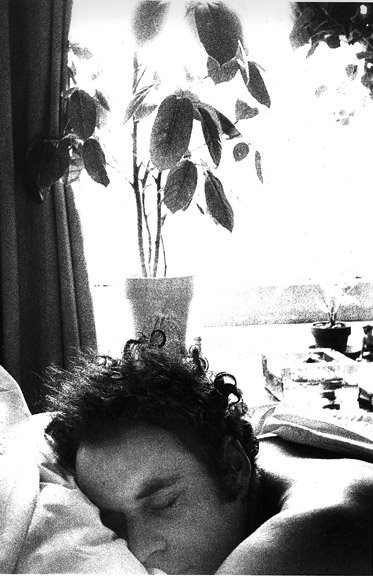
The photo is by Ralph Gibson.

Draft: Film and Literary Studies (BW) – 4-3-06
Literary studies of dreaming may begin with myth, folklore, and biblical criticism, and thus address the same cultural and psychological issues as the anthropology of dreaming. Folktales and religious scriptures featuring dreams set the models for later literature, from medieval dream visions to surrealist poems. The range of possible objects of study is extremely wide, and in offering some suggestions in our chapter on this topic, we try to focus on texts from different cultures and periods that are accessible, available, and perhaps most importantly, short enough to be actually read by your students.
In his introduction to The Dream Adventure (Orion, 1963), Roger Caillois identifies two main approaches to literary dreams: the psychological, which seeks an interpretation applying to the psychology of character or author (or by extension, to the group psychology of a society), and the philosophical, which uses the dream as a device to illustrate a metaphysical issue, or perhaps more properly, considers the genuine metaphysical questions raised by dreams. Contemporary classes may learn from Freudian or Jungian theories, apply the lessons of Gestalt therapy or Montague Ullman’s dream-appreciation seminars, or extend the horizon of topics from Western to Eastern literature, but the fundamental division in method remains the same. The psychological approach treats the dream as a coded message like others in the literary text to be decoded through the critic’s favored method; the philosophical approach may be more conducive to post-structuralist approaches like deconstruction, as it invites continual reconsideration of the ontological status of both the dream and the text. (Just think of Alice’s position in her underground adventures, trying to figure out whether she is actually dreaming, and the enduring appeal of the philosophical approach even to untrained readers is abundantly clear.) Both are of obvious relevance to contemporary classes in literature, especially when so many have branched out into popular culture, cultural studies, and alternative media, all of which present new contexts for dreams outside of traditional literary genres. (A third approach, which treats the literary dream as historical evidence, can add fascinating conundrums and new interest to history courses, particularly in periods when the dream vision is a prominent form as in the European Middle Ages.) Increasingly, instructors who invoke psychological theories in their teaching of literature must be prepared to offer the relevant accounts not only of depth psychology such as psychoanalysis, but also of contemporary brain science, mind-body philosophy, and cognitive psychology.


What is true of literature is, in this case, anyway, true of film, where the lessons of cognitive psychology are only beginning to be integrated into critical study. A limited number of courses on dreaming and cinema have been taught in the United States. Those initiated by psychology departments or instructors have emphasized the interpretation of dream sequences as revelation of character—as, perhaps most famously, in Ingmar Bergman’s masterpiece, Wild Strawberries. But courses developed by film instructors are more likely to broaden the focus beyond the psychology of character to consider dreams in relation to the many issues raised by the genres of fantasy, children’s film, and most recently, the spate of metaphysical fantasies such as The Matrix, Eternal Sunshine of the Spotless Mind, and Waking Life that testify to an unprecedented interest in dreaming among filmmakers and the general movie audience. Nearly every specialist on film has encountered the idea of the cinema as a form of collective dreaming. The difference among instructors is primarily in how they choose to investigate this analogy. Those who adhere to a realist theory that characterizes film essentially as a means of faithfully recording the objective world will treat cinematic dreaming as an interesting special case; others may find that films featuring dreams and dreaming consistently pose provocative challenges to realism.

Clearly, the fundamental topics in which dreaming can be of special interest in courses in literature and film studies are: the unique access that dreaming offers to the study of symbols generally; the models, derived from the theories of Freud, Jung, and other psychologists (including traditional non-Western sources only now becoming familiar in the United States) for understanding how dreams express the relation of the individual to the world; the genuine metaphysical questions raised by dreaming as they appear especially in self-reflexive texts; and the endlessly fascinating question of the relation of dreaming to the roots of imagination and creativity generally.

Dreaming may be not only an object of study but homework in a class in literature, film, or any of the humanities fields. Beginning (to the best of our knowledge) with Richard M. Jones’ courses at Evergreen State College in the 1970s, as described in The Dream Poet (Schenkman, 1979), many teachers of literature have found that asking students to keep a dream journal and raise their own dreams in class fuels their imaginative impulses and fosters a subjective identification with authors and characters that results in eager, engaged and creative interpretation of literary texts. Composition and creative-writing teachers have long found that dream-based assignments not only often result in an unlabored, unself-conscious that breathes new life into student writing, but also encourage active and empathetic listening when writing is shared in class.

Thursday, December 08, 2005

A Man Killed by His Dream

The Zuo Zhuan (about fifth century BC) tells the story of Shushun Bao of Lu, who traveled to Qi to meet his bride. Along the way he stopped at Geng Zong, where he met a woman who offered to bring him food. He spent the night with her.
Sometime after the birth of his two sons by the woman from Qi, he dreamed that the heavens were falling on him and crushing him to death. He called for help and saw a small, deformed man. "Niu (cow-like)!" he cried, "Help me!" But Niu did not assist him; he stood aside and watched. Shushun Bao pushed hard against the heavens and escaped. When he awoke he described the man in his dream and told his councillors to beware of him.
Years later he determined to return home from Qi to Lu. Along the way he stopped at Geng Zong, where the woman he had met long ago presented him with his son. "Niu," Shushun Bao said, before introductions could be made. "Yes," said the boy.
Niu accompanied Shushun Bao to Lu, where under the guise of protecting his father, he arranged the execution of his older half-brother and the exile of the younger. Attending his father Shushun Bao in illness, he withheld his medicine and watched as he died.

Friday, September 23, 2005

This summary is not available. Please click here to view the post.