-De Trinitate
Showing posts with label Quotes. Show all posts
Showing posts with label Quotes. Show all posts
Monday, October 29, 2007
Augustine of Hippo
Do not ask what truth is. For mists of corporeal images and clouds of phantasms will rise forthwith and confuse the clarity that flared up in you in a first impulse when I said: 'truth.' When the word 'truth' is spoken, remain if you can in the first impulse which struck you as a flash of lightning. But you cannot. You fall back into this world of familiar, earthly things.


Thursday, September 27, 2007
Friday, August 10, 2007
American Movie Critics: An Anthology from the Silents Until Now, Phillip Lopate, ed.
William Troy, "King Kong"
". . . unfortunately, it was thought necessary to mitigate some of the predominant horror by introducing a human. all-too-human theme. 'It was not the guns that got him,' says one of the characters at the end, after Kong has been brought to ground by a whole squadron of battle planes. 'It was Beauty killed the Beast.' By having Beauty, in the person of Miss Wray lure the great monster to his destruction, the scenario writers sought to unite two rather widely separated traditions of the popular cinema--that of the 'thriller' and that of the sentimental romance. The only difficulty was that they failed to realize that such a union was possible only by straining our powers of credulity and perhaps one or two fundamental laws of nature. For if the love that Kong felt for the heroine was sacred, it suggests a weakness that hardly fits with his other actions; and if it was, after all, merely profane, it proposes problems to the imagination that are not the less real for being crude."
"The Invisible Man"
"A body without a voice we have had on the silent screen, but not until this picture have we had a voice without a body."
These are two perfect film reviews. Troy was primarily a literary critic, and his emphasis is on plot - "scenario." But he has a terrific sense of how the uniqueness of the film experience arises from the paradoxes inherent in processing a representation of the inner world of fantasy presented in realistic visual and aural form. In criticizing Kong, he identifies the distinctive feature in the film's approach to love and sex, but he considers it as an error rather than as the enactment of a fantasy; it realizes its power, but he disapproves of it. And on aesthetic grounds, he's probably right.
What's great in him is that he recognizes so clearly the impact of the illusionistic qualities of film and how they push us towards the kind of thinking we do about plot and character. The recognition of the bad fit--and that's very, very bad joke--between two visions of sexuality is indeed the key to the movie, and works well with the later revisionist views that see Kong as about race. This essay alone makes me much more enthusiastic about including the original Kong in the Sex in Cinema class. (Previously I used only an excerpt. It's great to compare with the "Hot Voodoo" number from Blonde Venus--the one quoted in The Dreamers.
Robert Warshow, "A Feeling of Sad Dignity"
On Chaplin's Monsieur Verdoux and Limelight
Ralph Ellison, "The Shadow and the Act"
Martha Wolfenstein and Nathan Leites, "Got a Match?"
On the "masculine-feminine" girl in movies
Parker Tyler, "Double into Quadruple Indemnity" and "Warhol's New Sex Film"
Of course I think there should be a lot more Tyler in this anthology. This is the famous essay on the relationship between Walter and Keyes in Double Indemnity; and the essay on Warhol is one of the most lucid explanations of what he was up to (addressing the film Fuck).
Susan Sontag, "The Imagination of Disaster"
American Movie Critics: An Anthology from the Silents Until Now, Phillip Lopate, ed.
". . . unfortunately, it was thought necessary to mitigate some of the predominant horror by introducing a human. all-too-human theme. 'It was not the guns that got him,' says one of the characters at the end, after Kong has been brought to ground by a whole squadron of battle planes. 'It was Beauty killed the Beast.' By having Beauty, in the person of Miss Wray lure the great monster to his destruction, the scenario writers sought to unite two rather widely separated traditions of the popular cinema--that of the 'thriller' and that of the sentimental romance. The only difficulty was that they failed to realize that such a union was possible only by straining our powers of credulity and perhaps one or two fundamental laws of nature. For if the love that Kong felt for the heroine was sacred, it suggests a weakness that hardly fits with his other actions; and if it was, after all, merely profane, it proposes problems to the imagination that are not the less real for being crude."
"The Invisible Man"
"A body without a voice we have had on the silent screen, but not until this picture have we had a voice without a body."
These are two perfect film reviews. Troy was primarily a literary critic, and his emphasis is on plot - "scenario." But he has a terrific sense of how the uniqueness of the film experience arises from the paradoxes inherent in processing a representation of the inner world of fantasy presented in realistic visual and aural form. In criticizing Kong, he identifies the distinctive feature in the film's approach to love and sex, but he considers it as an error rather than as the enactment of a fantasy; it realizes its power, but he disapproves of it. And on aesthetic grounds, he's probably right.
What's great in him is that he recognizes so clearly the impact of the illusionistic qualities of film and how they push us towards the kind of thinking we do about plot and character. The recognition of the bad fit--and that's very, very bad joke--between two visions of sexuality is indeed the key to the movie, and works well with the later revisionist views that see Kong as about race. This essay alone makes me much more enthusiastic about including the original Kong in the Sex in Cinema class. (Previously I used only an excerpt. It's great to compare with the "Hot Voodoo" number from Blonde Venus--the one quoted in The Dreamers.
Robert Warshow, "A Feeling of Sad Dignity"
On Chaplin's Monsieur Verdoux and Limelight
Ralph Ellison, "The Shadow and the Act"
Martha Wolfenstein and Nathan Leites, "Got a Match?"
On the "masculine-feminine" girl in movies
Parker Tyler, "Double into Quadruple Indemnity" and "Warhol's New Sex Film"
Of course I think there should be a lot more Tyler in this anthology. This is the famous essay on the relationship between Walter and Keyes in Double Indemnity; and the essay on Warhol is one of the most lucid explanations of what he was up to (addressing the film Fuck).
Susan Sontag, "The Imagination of Disaster"
American Movie Critics: An Anthology from the Silents Until Now, Phillip Lopate, ed.
Thursday, August 09, 2007
American Movie Critics: An Anthology from the Silents Until Now, Phillip Lopate, ed.
Vachel Lindsay, "The Photoplay of Action" and "The Artistic Position of Douglas Fairbanks and The Thief of Bagdad Production"
Lindsay seems like the definitively outdated, time-bound poet--those rhythmic incantations high-school students memorize--but his judgments on film are incredibly subtle, broad-minded, and far-seeing. The D. Fairbanks essay is a defense of Entertainment against the demands of Art.
Robert E. Sherwood, "The Ten Commandments" and "Greed"
"The Ten Commandments may not exercise as much influence as they should, but they are certainly good theater."
H. L. Mencken, "Note on Technic"
"What afflicts the movies is not an unpalatable ideational content so much as an idiotic and irritating technic. . . . How can one work up any rational interest in a fable that changes its locale and its characters ten times a minute? Worse, this dizzy jumping about is plainly unnecessary: all it shows is the professional incompetence of the gilded pants-pressers, decayed actors and other such half-wits to whom the making of movies seems to be entrusted. Unable to imagine a sequence of coherent scenes, and unprovided with a sufficiency of performers capable of playing them if they were imagined, these preposterous mountebanks are reduced to the childish device of avoiding action altogether. Instead of it they present what is at bottom nothing but a poorly articulated series of meaningless postures and grimaces. One sees a ham cutting a face, and the one sees his lady co-star squeezing a tear--and so on, endlessly. . . . If, at the first attempt upon a scene, the right attitude is not struck, then all they have to do is keep trying until they strike it. On those terms a chimpanzee could play Hamlet, or even Juliet.
"To most of the so-called actors engaged in movies, I daresay, no other course would be possible. . . . They are engaged, not for their histrionic skill, but simply for their capacity to fill the heads of romantic virgins and neglected wives with the sort of sentiments that the Christian religion tries so hard to put down. . . . The worst of it is that the occasional good actor, venturing into the movies, is brought down to the common level by the devices thus invented to conceal the incompetence of his inferiors. It is quite as impossible to present a plausible impersonation in a series of unrelated (and often meaningless) postures as it would be to make a sensible speech in a series of college yells. So the good actor, appearing in the films, appears to be almost as bad as the natural movie ham. One sees him only as one sees a row of telegraph poles, riding in a train. . . .
"All this is ingenious. More, it is humane, for it prevents the star trying to act, and so saves the spectators pain. But it is manifestly a poor substitute for acting on the occasions when acting is actually demanded by the plot--that is, on the occasions when there must be cumulative action, and not merely a series of postures. . . . In the movies they are dismembered, and so spoiled. Try to imagine the balcony scene from "Romeo and Juliet" in a string of fifty flashes--first Romeo taking his station and spitting on his hands, then Juliet with her head as big as a hay-wagon, then the two locked in a greasy kiss, then the Nurse taking a drink of gin, then Romeo rolling his eyes, and so on. If you can imagine it, then you ought to be in Hollywood, dodging bullets and amassing wealth. . . ."
This is very interesting to read in conjunction with Noel Carroll's A Philosophy of Mass Art, as I'm doing. Clement Greenberg and Adorno and Horkheimer's arguments against mass forms like movies turn on the idea that they make the audience intellectually lazy--Greenberg hilariously insists that the reception of real art should be hard work--where do they come up with these things?--while Adorno and Horkheimer more sensibly fear the cultivation of the habit of passive reception. An essay like Mencken's, coming relatively early in the history of film, clarifies the obvious point that the claim that mass media are easy or passive is bogus. (Carroll is very good at showing that the key terms in most of these arguments are incoherent, biased, or entirely artificial. He's also very good at briefly showing how Kant's ideas about aesthetic judgment are illegitimately extended to art--as if the objects of judgment should display the same characteristics as judgment does. I'm so poorly educated I never realized this before, but my excuse is that the arguments based on this mistake--like Greenberg's--always seemed to me so ridiculous that they were not worth considering in detail.)
Then there is this extraordinary diatribe:
"A successful movie mime is probably the most admired human being ever seen in the world. He is admired more than Napoleon, Lincoln or Beethoven; more, even, than Coolidge. The effects of this adulation, upon the mime himself and especially upon his clients, ought to be given serious study by competent psychiatrists, if any can be found. For there is nothing more corrupting to the human psyche, I believe, than the mean admiration of mean things. It produces a double demoralization, intellectual and spiritual. Its victim becomes not only a jackass, but also a bounder. The movie-parlors, I suspect, are turning out such victims by the million: they will, in the long run, so debauch the American proletariat that it will begin to put Coolidge above Washington, and Peaches Browning above Coolidge. . . ."
American Movie Critics: An Anthology from the Silents Until Now, Phillip Lopate, ed.
Monday, March 19, 2007
Thoreau
Thoreau's Journal, edited by Lawrence Stapleton in the Dover edition, begins with one of the best comments I ever read on journal-keeping:
We should not endeavor coolly to analyze our thoughts, but, keeping the pen even and parallel with the current, make an accurate transcript of them.
We should not endeavor coolly to analyze our thoughts, but, keeping the pen even and parallel with the current, make an accurate transcript of them.
-March 7 1838
Other Thoreau quotes I'm compiling for use in class (from "Walking," "Life Without Principle," "Civil Disobedience"):
A town is saved, not more by the righteous men in it than by the woods and swamps that surround it.
I would not have every man nor every part of a man cultivated, any more than I would have every acre of earth cultivated.
I believe in the forest, and in the meadow, and in the night in which the corn grows.
Really to see the sun rise or go down every day, so to relate ourselves to a universal fact, would preserve us sane forever.
All good things are wild and free.
We do not live for idle amusement. I would not run round a corner to see the world blow up.
In proportion as our inward life fails, we go more constantly and desperately to the post office.
The opportunities of living are diminished in proportion as what are called the 'means' are increased.
The ways by which you may get money almost without exception lead downwards.
There is something servile in the habit of seeking after a law which we may obey.
Is democracy, such as we know it, the last improvement possible in government?
Can there not be a government in which majorities do not virtually decide right and wrong, but conscience?
Let your life be a counter friction to the machine.
And from Walden:
A stereotyped but unconscious despair is concealed even under what are called the games and amusements of mankind.
I wish I'd thought to include that as an epigraph to Mythomania.
And finally:
The greater part of what my neighbors call good I believe in my soul to be bad, and if I repent of anything, it is very likely to be my good behavior.
This last is much on my mind lately, and the major theme in what it occurs to me to write in fiction and plays.
Other Thoreau quotes I'm compiling for use in class (from "Walking," "Life Without Principle," "Civil Disobedience"):
A town is saved, not more by the righteous men in it than by the woods and swamps that surround it.
I would not have every man nor every part of a man cultivated, any more than I would have every acre of earth cultivated.
I believe in the forest, and in the meadow, and in the night in which the corn grows.
Really to see the sun rise or go down every day, so to relate ourselves to a universal fact, would preserve us sane forever.
All good things are wild and free.
We do not live for idle amusement. I would not run round a corner to see the world blow up.
In proportion as our inward life fails, we go more constantly and desperately to the post office.
The opportunities of living are diminished in proportion as what are called the 'means' are increased.
The ways by which you may get money almost without exception lead downwards.
There is something servile in the habit of seeking after a law which we may obey.
Is democracy, such as we know it, the last improvement possible in government?
Can there not be a government in which majorities do not virtually decide right and wrong, but conscience?
Let your life be a counter friction to the machine.
And from Walden:
A stereotyped but unconscious despair is concealed even under what are called the games and amusements of mankind.
I wish I'd thought to include that as an epigraph to Mythomania.
And finally:
The greater part of what my neighbors call good I believe in my soul to be bad, and if I repent of anything, it is very likely to be my good behavior.
This last is much on my mind lately, and the major theme in what it occurs to me to write in fiction and plays.
Friday, December 15, 2006
Almost done grading, working on a conference proposal, looking forward to working on the poem for Colby's show and some other writing during the break. When I spend a lot of timne alone, I always start thinking about this poem by Coleridge:
THIS LIME-TREE BOWER MY PRISON
This Lime-Tree Bower My Prison
[Addressed to Charles Lamb of the India House, London]
Well, they are gone, and here must I remain,
This lime-tree bower my prison! I have lost
Such beauties and such feelings, as had been
Most sweet to have remembrance, even when age
Had dimm'd mine eyes to blindness! They, meanwhile,
Friends, whom I never more may meet again,
On springy heath, along the hilltop edge,
Wander in gladness, and wind down, perchance,
To that still roaring dell, of which I told;
The roaring dell, o'erwooded, narrow, deep,
And only speckled by the mid-day sun;
Where its slim trunk the ash from rock to rock
Flings arching like a bridge; —that branchless ash,
Unsunn'd and damp, whose few poor yellow leaves
Ne'er tremble in the gale, yet tremble still,
Fann'd by the water-fall! and there my friends
Behold the dark green file of long lank weeds,
That all at once (a most fantastic sight!)
Still nod and drip beneath the dripping edge
Of the blue clay-stone.
Now my friends emerge
Beneath the wide wide Heaven—and view again
The many-steepled tract magnificent
Of hilly fields and meadows, and the sea,
With some fair bark, perhaps, whose sails light up
The slip of smooth clear blue betwixt two Isles
Of purple shadow! Yes! they wander on
In gladness all; but thou, methinks, most glad,
My gentle-hearted Charles! For thou hast pined
And hunger'd after Nature, many a year,
In the great City pent, winning thy way
With sad yet patient soul, through evil and pain
And strange calamity! Ah! slowly sink
Behind the western ridge, thou glorious Sun!
Shine in the slant beams of the sinking orb,
Ye purple heath-flowers! richlier burn, ye clouds!
Live in the yellow light, ye distant groves!
And kindle, thou blue Ocean! So my friend,
Struck with deep joy, may stand, as I have stood,
Silent with swimming sense; yea, gazing round
On the wide landscape, gaze till all doth seem
Less gross than bodily; and of such hues
As veil the Almighty Spirit, when he makes
Spirits perceive his presence.
A delight
Comes sudden on my heart, and I am glad
As I myself were there! Nor in this bower,
This little lime-tree bower, have I not mark'd
Much that has sooth'd me. Pale beneath the blaze
Hung the transparent foliage; and I watch'd
Some broad and sunny leaf, and loved to see
The shadow of the leaf and stem above
Dappling its sunshine! And that walnut-tree
Was richly ting'd, and a deep radiance lay
Full on the ancient ivy, which usurps
Those fronting elms, and now with blackest mass
Makes their dark branches gleam a lighter hue
Through the late twilight: and though now the bat
Wheels silent by, and not a swallow twitters,
Yet still the solitary humble-bee
Sings in the bean-flower! Henceforth I shall know
That nature ne'er deserts the wise and pure;
No plot so narrow, be but Nature there
No waste so vacant, but may well employ
Each faculty of sense, and keep the heart
Awake to Love and Beauty! and sometimes
'Tis well to be bereft of promised good,
That we may lift the soul, and contemplate
With lively joy the joys we cannot share.
My gentle-hearted Charles! when the last rook
Beat its straight path along the dusky air
Homewards, I blessed it! deeming its black wing
(Now a dim speck, now vanishing in light)
Had cross'd the mighty Orb's dilated glory
While thou stood'st gazing; or, when all was still,
Flew creaking o'er thy head, and had a charm
For thee, my gentle-hearted Charles, to whom
No sound is dissonant which tells of Life.
(This poem is in the background of Songs, the last poem I did as a collaboration with Colby.)
Had a great note from R. J. March. I'd written to him to tell him I sent Dennis Cooper some praise of him to post on Dennis' blog on Porn Writing Day. He turns out to be a big DC fan, and thrilled to be brought to the Great One's notice. So it's always a good idea to let someone know you like their work; it's not like it's ever bad news.
Long phone call with Kelly and Phil on the dream education book. I'm working on a guide to proposing a course and on some ideas for teaching the "sociology" of the history of depth psychology, organizing study of anthropological perspectives on dreaming, the value of in-class dream workshops, and a few other topics.
THIS LIME-TREE BOWER MY PRISON
This Lime-Tree Bower My Prison
[Addressed to Charles Lamb of the India House, London]
Well, they are gone, and here must I remain,
This lime-tree bower my prison! I have lost
Such beauties and such feelings, as had been
Most sweet to have remembrance, even when age
Had dimm'd mine eyes to blindness! They, meanwhile,
Friends, whom I never more may meet again,
On springy heath, along the hilltop edge,
Wander in gladness, and wind down, perchance,
To that still roaring dell, of which I told;
The roaring dell, o'erwooded, narrow, deep,
And only speckled by the mid-day sun;
Where its slim trunk the ash from rock to rock
Flings arching like a bridge; —that branchless ash,
Unsunn'd and damp, whose few poor yellow leaves
Ne'er tremble in the gale, yet tremble still,
Fann'd by the water-fall! and there my friends
Behold the dark green file of long lank weeds,
That all at once (a most fantastic sight!)
Still nod and drip beneath the dripping edge
Of the blue clay-stone.
Now my friends emerge
Beneath the wide wide Heaven—and view again
The many-steepled tract magnificent
Of hilly fields and meadows, and the sea,
With some fair bark, perhaps, whose sails light up
The slip of smooth clear blue betwixt two Isles
Of purple shadow! Yes! they wander on
In gladness all; but thou, methinks, most glad,
My gentle-hearted Charles! For thou hast pined
And hunger'd after Nature, many a year,
In the great City pent, winning thy way
With sad yet patient soul, through evil and pain
And strange calamity! Ah! slowly sink
Behind the western ridge, thou glorious Sun!
Shine in the slant beams of the sinking orb,
Ye purple heath-flowers! richlier burn, ye clouds!
Live in the yellow light, ye distant groves!
And kindle, thou blue Ocean! So my friend,
Struck with deep joy, may stand, as I have stood,
Silent with swimming sense; yea, gazing round
On the wide landscape, gaze till all doth seem
Less gross than bodily; and of such hues
As veil the Almighty Spirit, when he makes
Spirits perceive his presence.
A delight
Comes sudden on my heart, and I am glad
As I myself were there! Nor in this bower,
This little lime-tree bower, have I not mark'd
Much that has sooth'd me. Pale beneath the blaze
Hung the transparent foliage; and I watch'd
Some broad and sunny leaf, and loved to see
The shadow of the leaf and stem above
Dappling its sunshine! And that walnut-tree
Was richly ting'd, and a deep radiance lay
Full on the ancient ivy, which usurps
Those fronting elms, and now with blackest mass
Makes their dark branches gleam a lighter hue
Through the late twilight: and though now the bat
Wheels silent by, and not a swallow twitters,
Yet still the solitary humble-bee
Sings in the bean-flower! Henceforth I shall know
That nature ne'er deserts the wise and pure;
No plot so narrow, be but Nature there
No waste so vacant, but may well employ
Each faculty of sense, and keep the heart
Awake to Love and Beauty! and sometimes
'Tis well to be bereft of promised good,
That we may lift the soul, and contemplate
With lively joy the joys we cannot share.
My gentle-hearted Charles! when the last rook
Beat its straight path along the dusky air
Homewards, I blessed it! deeming its black wing
(Now a dim speck, now vanishing in light)
Had cross'd the mighty Orb's dilated glory
While thou stood'st gazing; or, when all was still,
Flew creaking o'er thy head, and had a charm
For thee, my gentle-hearted Charles, to whom
No sound is dissonant which tells of Life.
(This poem is in the background of Songs, the last poem I did as a collaboration with Colby.)
Had a great note from R. J. March. I'd written to him to tell him I sent Dennis Cooper some praise of him to post on Dennis' blog on Porn Writing Day. He turns out to be a big DC fan, and thrilled to be brought to the Great One's notice. So it's always a good idea to let someone know you like their work; it's not like it's ever bad news.
Long phone call with Kelly and Phil on the dream education book. I'm working on a guide to proposing a course and on some ideas for teaching the "sociology" of the history of depth psychology, organizing study of anthropological perspectives on dreaming, the value of in-class dream workshops, and a few other topics.
Thursday, August 10, 2006
The Invisible Machine
I'm studying up on Utopias to teach a couple of courses aligned with the Modernism exhbitiion planned for the Corcoran in Spring 2007. Every time I take on a topic, it seems to me the one thing that explains everything in the world that we're not getting (even though it's always some point that's painfully obvious--my whole life theme seems to be that what's most important is what we're overlooking). But this passage from Lewis Mumford's essay, "Utopia, the City and the Machine" is particularly clarifying:
The many genuine improvements that science and technics have introduced into every aspect of existence have been so notable that it is perhaps natural that its grateful bneficiaries should have overlooked the ominous social context in which these changes have taken place, as well as the heavy price we have already paid for them, and the still more forbidding price that is in prospect. Until the last generation it was possible to think of the various components of techonology as additive. This meant that each new mechanical invention, each new scientific discovery, each new application to engineering, agriculture, or medicine, could be judged separately on its own performance, estimated eventually in terms of the human good accomplished, and diminished or eliminated if it did not in fact promote human welfare.
This belief has now proved an illusion. Though each new invention or discovery may respond to some genuine human need, or even awaken a fresh human potentiality, it immediately becomes part of an articulated totalitarian system that, on its own premises, has turned the machine into a god whose power must be increased, whose prosperity is essential to all existence, and whose operations, however irrational or compulsive, cannot be challenged, still less modified.
The only group that has understood the dehumanizing effects of the Invisible Machine are the avant-garde artists, who have caricatured it by going to the opposite extreme of disorganization. Their calculated destructions and "happenings" symbolize total decontrol: the rejection of order, continuity, design, significance, and a total inversion of human values which turns criminals into saints and scrambled minds into sages. In such anti-art, the dissolution of our entire civilization into randomness and entropy is prophetically symboliozed. In their humorless deaf-and-dumb language, the avant-garde arrtists reach the same goal as scientists and technicians, but by a different route--both seek or at least welcome the displacement of and the eventual elimination of man. In short, both the further affirmation of the mechanical utopia and its total rejection would beget dystopia. Wherever human salvation may lie, neither utopia nor dystopia, as now conceived, promises it.
The many genuine improvements that science and technics have introduced into every aspect of existence have been so notable that it is perhaps natural that its grateful bneficiaries should have overlooked the ominous social context in which these changes have taken place, as well as the heavy price we have already paid for them, and the still more forbidding price that is in prospect. Until the last generation it was possible to think of the various components of techonology as additive. This meant that each new mechanical invention, each new scientific discovery, each new application to engineering, agriculture, or medicine, could be judged separately on its own performance, estimated eventually in terms of the human good accomplished, and diminished or eliminated if it did not in fact promote human welfare.
This belief has now proved an illusion. Though each new invention or discovery may respond to some genuine human need, or even awaken a fresh human potentiality, it immediately becomes part of an articulated totalitarian system that, on its own premises, has turned the machine into a god whose power must be increased, whose prosperity is essential to all existence, and whose operations, however irrational or compulsive, cannot be challenged, still less modified.
The only group that has understood the dehumanizing effects of the Invisible Machine are the avant-garde artists, who have caricatured it by going to the opposite extreme of disorganization. Their calculated destructions and "happenings" symbolize total decontrol: the rejection of order, continuity, design, significance, and a total inversion of human values which turns criminals into saints and scrambled minds into sages. In such anti-art, the dissolution of our entire civilization into randomness and entropy is prophetically symboliozed. In their humorless deaf-and-dumb language, the avant-garde arrtists reach the same goal as scientists and technicians, but by a different route--both seek or at least welcome the displacement of and the eventual elimination of man. In short, both the further affirmation of the mechanical utopia and its total rejection would beget dystopia. Wherever human salvation may lie, neither utopia nor dystopia, as now conceived, promises it.
Thursday, January 05, 2006
This is a comment from William Gibson's blog, not a bad thing to remember when you're astounded, as I often am, at how little actual work you're getting done:
I suspect I have spent just about exactly as much time actually writing as the average person my age has spent watching television, and that, as much as anything, may be the real secret here.
Monday, January 02, 2006
How Come There's Never a Barbarian Around When You Need One?
Falling ill at the wrong moment, the unfortunate [Manius Aquillius, Roman commander] was captured and dragged back to Pergamum, shackled all the way to a seven-foot barbarian. After tying him to an ass and parading him through jeering crowds, Mithridates next ordered some treasure melted down. When all had been prepared, Aquillius' head was jerked back, his mouth forced open, and the molten metal poured down his throat. 'Warmongers against every nation, people and king under the sun, the Romans have only one abiding motive--greed,deep-seated, for empire and riches.' This had been the verdict of Mithridates on the Republic and now, in the person of her legate in Asia, he exacted symbolic justice. Manius Aqullius choked to death on gold.-Tom Holland, Rubicon
Wednesday, November 02, 2005
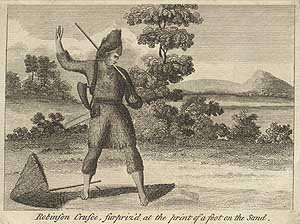 I had been telling him how the Devil was God's enemy in the Hearts of Men, and used all his Malice and Skill to defeat the good Designs of Providence, and to ruine the Kingdom of Christ in the World; and the like. Well, says Friday; but you say, God is so strong, so great, is he not much strong, much might as the Devil? Yes, yes, says I , Friday, God is stronger than the Devil, and therefore we pray to God to tread him down under our Feet, and enable us to resist his Temptations and quench his fiery Darts. But, he says again, if God much strong, much might as the Devil, why God no kill the Devil, so make him do no more wicked?
I was strangely surpriz'd at his Question, and after all, tho' I was now an old Man, yet I was but a young Doctor, and ill enough quallified for a Casuist, or a Solver of Difficulties: And at first I could not tell what to say, so I pretended not to hear him, and ask'd him what he said. But he was too earnest for an Answer to forget his Question; so that he repeated it in the very same broken Words, as above. By this time I had recovered my self a little, and I said, God will at last punish him severely; he is reserv'd for the Judgement, and is to be cast into the Bottomless-Pit, to dwell with everlasting Fire: This did not satisfie Friday, but he returns upon me, repeating my Words, RESERVE, AT LAST, me no understand; but, why not kill the Devil now, not kill great ago?
Monday, October 17, 2005
 More About Dionysos
For Vernant, Dionysos was the god who crosses the boundaries and confuses reality and illusion, who makes us lose in his collective our self-
consciousness and identity of self. Tragedy is appropriately Dionysiac when we suspend our disbelief in watching the drama and enter a world of mimesis, a world presided over by the mask behind which individual identity is hidden.
-Storey and Allan, Guide to Ancient Greek Drama (Blackwell)
That's fine, but "lose" should be in quotation marks, because self-consciousness and identity aren't "lost," they're simply relegated to another part of awareness. The "confusion" of reality and illusion in drama is itself an illusion, responsible for a lot of the enjoyment of illusion in art. This seems to be the easiest thing in the world to get confused about, but it does remind us that the inadequacy of our ways of describing "illusion" is due to the inadequacy of our ways of describing "reality."
Really, someone ought to do something about it.
 Stop Me If You've Heard This One Before
The entire comedy of art is neither performed for our betterment or education nor are we the true authors of this art world. On the contrary, we may assume that we are merely images and artistic projections for the true author, and that we have our highest dignity in our significance as works of art--for it is only as an aesthetic phenomenon that existence and the world are eternally justified--while of course our consciousness of our own significance hardly differs from that which the soliders painted on canvas have of the battle represented on it. Thus all our knowledge of art is basically quite illusory . . .
--Nietzsche, Birth of Tragedy
Monday, September 26, 2005

I don't really know much about Confucius; I think I only finally read The Analects (though I completely forget what that's supposed to mean) when it occurred to me I might use him in a Humanities section on The Good Society. I didn't. So I can't even claim, because I don't know the context, that he's a model for the aphoristic writer. I know Walter Benjamin remarked somewhere that the literature of the future would consist of aphorisms; I'm sure he had reasons for saying so. I'm simply reporting my taste, a personal inclination for pithy statements that open up to contemplation, that are more likely to be sublime than beautiful, that are true without pretending to proclaim a truth.
As I got older, I started to really enjoy writers I avoided when I was young; in fact, generically I still prefer fiction and plays to the pretensions of of the cntemporary market for editorials, opinions and theories. (But who doesn't like biography? It ought to count as a genre of fiction.) I like Wilde, Thoreau, Epictetus, Diogenes, Montaigne, Thomas Browne, Samuel Johnson--of course Gertrude Stein, who herself said, "Remarks are not literature," but was awfully good at producing memorable ones. I never would have thought even in grad school, when I was only starting to get over my resentment of canons enough to enjoy reading even books that seemed like monuments in "the tradition," that I would get so much pleasure out of reading Samuel Johnson (well, you have to start with Boswell's Life, because that's where most of the endearing funny remarks are).
Anyway, Confucius said several things that have remained on my list of best pithy remarks ever:
Some are the kind of axioms we put on posters to encourage the right attitude in teachers and administrators:
The gentleman helps others to realize what is good in them; he does not help them realize what is bad in them. The small man does the opposite.
If a man is correct in his own person, then there will be obedience without orders being given; but if he is not correct in his own person, there will not be obedience even though orders are given.
What the gentleman seeks, he seeks within himself; what the small man seeks, he seeks in others.
Some are just wise:
In his errors a man is true to type. Observe his errors and you will know the man.
In his dealings with the world the gentleman is not invariably for or against anything. He is on the side of what is moral.
To be fond of something is better than merely to know it, and to find joy in it is better than merely to be fond of it.
It is these things that cause me concern: failure to cultivate virtue; failure to go more deeply into what I have learned; inability, when I am told what is right, to move where it is; and inability to reform myself when I have defects.
Confucian irony is hilarious:
A man from a village in Ta Hsiang said, "Great indeed is Confucius! He has wide learning but has not made a name for himself in any field." The Master on hearing this said to his disciples, "What should I make myself proficient in? In driving? Or in archery? I think I would prefer driving."
And at least one thing he said is sort of my watchword:
The way out is through the door. Why then does no one use this way?
Confucius. He was righteous. Nice hat, by the way.
Subscribe to:
Posts (Atom)


 Posts
Posts

