Monday, April 16, 2007

Wild Strawberries


This will appear in the next issue of DreamTime, the membership journal of the International Association for the Study of Dreams:


Most serious film critics who attempt to sort out relation of dreaming to cinema start with an obvious distinction, inferred from the conventions of the fiction films they study: There are films that are relevant because of their celebrated or notable dream sequences, like Hitchcock’s Spellbound or Vertigo, and films structured as dream visions, like The Wizard of Oz, or Richard Linklater’s underrated metaphysical fantasy, Waking Life. The latter is an ancient form, with a history in many media, and a tradition of critical interpretation as allegory, supernatural revelation, or philosophical statement on the nature of being in the world; the former is usually approached in the terms of twentieth-century psychology—especially Freudian—as a mystery to be decoded for clues to the dreaming character’s state of mind.

Very rarely does a film transcend this useful distinction and treat dreaming both as a device to present a glimpse into a character’s psychological state and as a means of elevating cinema to the condition of spiritual quest—considering, like the great artistic dream journeys of the past, the existential questions of authentic being, full engagement with the human world, and confrontation with one’s own developing and incomplete identity. Certainly no other film has integrated these two approaches to the cinematic use of dreaming with such consummate artistry as does the great Swedish director Ingmar Bergman in Wild Strawberries (Smultronstället, 1957), a kind of modern Pilgrim’s Progress, but executed with the complex understanding of character of the dramas of Ibsen or Strindberg.

One of Bergman’s greatest insights was to recognize that the transcendent aspects of life—the sources of the religious experience he so often made his subject—could be addressed in film not through stylized attempts to depict the supernatural but by bringing the audience progressively further into a single character’s mind. The game of chess played with Death himself in Bergman’s The Seventh Seal (1957) remains justly famous, but largely through parody of its heavy-handed symbolism. By contrast, Wild Strawberries achieves profound impact in a scene in which a character simply recites a poem about finding God in nature, while dining in the open air.

The plot of the film, too, is simple—Isak Borg makes the long car trip to the university town of Lund to be honored for his life’s work as a doctor. Accompanying him is his daughter-in-law, who’s estranged from her husband, and along the way they encounter characters who all raise variants on the same question: Has Isak lived so cerebrally, so rigidly adhering to his own code of rectitude, than he has failed to experience the real humanity in himself and others? The incidents are mirrors that reflect his own failings to himself, though sometimes they comfort him with knowledge of the good he has done.

Yet Isak Borg is a character who lives as much in dreams, fantasies and reveries as in his present reality. His day begins with one of the most famous dreams in film history, loaded with symbolism of clocks, coffins, and empty streets that many critics have labeled “Freudian,” though Bergman himself has only hinted that it is an homage to the German expressionist films that impressed and disturbed him in his youth. It is—not to spoil the experience for readers who haven’t seen the film yet—a classic confrontation with mortality. The dream disturbs Isak enough that he determines to drive all the way to Lund instead of flying, the film’s first indication that its theme will be Isak’s growing awareness that he must accept rather than avoid life.
His second dream comes during a rest stop, as he wants to show his daughter-in-law the house where he spent summers as a child. This seems a kind of reverie, exactly recapitulating scenes from his early years, concerned with the petty jealousies and infidelities of adolescence, especially his unsuccessful pursuit of his cousin Sara, who ultimately prefers his more playful and lively brother.

His third dream, as he sleeps in the car while his daughter-in-law drives, returns to the theme, beginning with a fantasied conversation with the young Sara in which she explains just why she rejected him, and ending with a scene—remembered or imagined—of his wife’s adultery some years later. The intervening scene is another great exercise in convincing dream symbolism, an extraordinary achievement of capturing the real feel of a dream: Isak is required to take an unexpected examination, in an unknown language, in which he seems to fail completely in the elementary skills required of a doctor.

Two points become very clear as one examines these dreams: First, the tendency of the mainstream of American film criticism, from the intellectual establishment of the 1950s to recent post-structuralist theories, to ground all consideration of symbolism in Freudian terms seems especially misguided and inadequate here. All of Borg’s dreams so vividly illustrate Jung’s concept of compensation—that the content of the dream compensates for an unbalanced view of self and life in waking existence—that they might be used as textbook examples. Second, the complaint made by a few critics (and more viewers) that Isak’s dreams are haphazard, aimless interruptions of the narrative manifestly misreads the real structure of the film. Bergman—the writer as well as director—clearly considers carefully the different nature of each of Isak’s extended side-journeys into the subjective view. Though a Jungian reading of Wild Strawberries is convincingly neat, the Swedish director is after something larger. By emphasizing not only dream, but memory and fantasy, he goes beyond the illustration of concepts established in depth psychology, and subtly influences the audience’s ideas about the capacities of cinema itself. (Considering that his career as a screenwriter and director stretches from 1943 to the present—more than half the history of the artform—at least in hindsight he ought to qualify almost uniquely to do so.)

There are many tantalizing themes to take up in Wild Strawberries: the tension in Protestant theology, and this in western ethics, between the value of works and faith; the two characters named Sara, who appear in Isak’s old age as well as his youth, suggesting a notion of the anima or Eternal Feminine at the heart of the film; even the slight hints that Bergman is quite aware of the film’s indebtedness to Dickens’ A Christmas Carol—itself a modern dream vision never fully appreciated by literary criticism. But the uniqueness of this film—consistently appearing on critics’ lists of the ten greatest masterworks of cinema, even as they frequently condescend to its “old-fashioned” and “literary” character—is truly in its structure. In the heyday of documentary realism—which has its own virtues but became a dominating paradigm squeezing out other approaches to film—Bergman took up the most foundational questions of cinema, the ones that require constant reinvestigation, by exploring not technique but representation itself, the relation of cinematic images to lived experience, and he did so, in Wild Strawberries, by showing us the continuity of dream, fantasy, and memory, and how much of our lives may be absorbed in them, and in meaningful subjective experience, in the course of a single day. The most significant function of art, as of dreams, is subversive—to show us that the words we use in the day are inadequate to our real experience, and that we must always remain open to new ways of framing and understanding that experience—new images, new subjective events, that can deepen our limited understanding of the world. Wild Strawberries constitutes its own theory of representation, and whatever else we find it, it teaches us something just be holding that our accustomed account of the relation of the individual to the world, and of the nature of perception and memory, is inadequate to our lives —and this is the most important work that the fictional worlds of cinema can do. Wild Strawberries thus stands as the distinguished forebear of virtually every recent film that challenges the metaphysics of everyday life—Memento, Pi, Eternal Sunshine of the Spotless Mind, and even such as apparently anti-Bergmanesque spectacles as The Matrix.

Wild Strawberries is available on DVD in a beautiful print from Criterion. Extras include a great documentary on Bergman’s life and work by Jorn Donner.

Sunday, April 15, 2007

The Dream Body of George W. Bush

This was written at the turn of this year and just published by Elizabeth van Fleet in Spot, a magazine she edited at St. Mary's College of Maryland.

I wake up—I wake up inside the dream, you understand—and I’m in my freshman dorm room, in my bed. It’s a narrow bunk bed; I couldn’t sit up without bumping my head. Sometimes when I got into it, it felt like I was climbing into my coffin. Anyway, I wake up—inside the dream—and my roommate, F---, is just standing there in the semi-dark, turned away from me, in his pajamas. My freshman roommate was a very dorky guy, who wore pajamas and picked his nose right in front of me. He turns slightly toward me and I can see he’s got a hunting knife, a big, scary-looking, slasher-movie kind of knife, like you’d gut a deer with.
Then he smiles down at me and he hasn’t got a knife in his hand anymore. He’s a got this unworldly big hardon tenting his jammies, like a fireplug, thicker than a guy’s dick could possibly be. He rubs it just a little, smiling. Then it’s like there’s a close-up of his face, or maybe he’s leaning in over me, and I see he’s got blood in his mouth, like his gums were bad or he bit his tongue or something, but he’s still smiling, and he’s turned into George W. Bush, like he looks in those pictures from his Texas Air National Guard service, grinning like he knows exactly what I’m thinking.

* * * *

My friend M--- and I are on an assembly line, in chef’s hats and smocks, like Lucy and Ethel, and there are candies coming by, we’re trying to roll them in chocolate but of course they’re coming too fast, so instead of freaking out like Lucy and Ethel in the show we just laugh and laugh like we’re stoned, and the guy in charge comes out like he does in the TV show, only it’s George W. Bush, and he looks at us in disgust. Then he reaches over and takes my friend’s chin, but gently, into his hand, and then he suddenly spits, hard, into my friend’s face, like a cobra spitting venom. And my friend’s head explodes. And then he turns to me and says, “Now you clean this mess up,” and leaves, and I start trying to clean up, and then the assembly line starts again and a coffin comes down the line and I have to drape an American flag over it and salute it as—the assembly line is like as long as a football field now—as it disappears out of sight.

* * * *

The night before my wedding two years ago, I had this strange dream: I’m back in the high-school locker room, and I’m stripping off my football uniform. There are a couple of other guys around doing the same. But beyond, I can see a very brightly lit white space, like a typical Chelsea art gallery, with people standing around. I recognize people I’ve seen on TV: Condoleeza Rice, Dick Cheney, Nancy Pelosi, Antonin Scalia. They’re all holding drinks and laughing. And then I see the guys and girls I knew in high school, the football players and cheerleaders, in typical Manhattan cater-waiter outfits, serving them.
For some reason, even though they can see me, I don’t mind at all walking past them completely naked, just carrying a towel, on my way to the shower. When I enter the shower room, the perspective gets all weird, like in Carrie: there’s only one guy there, but it’s like my field of vision has narrowed so he’s all I see, even though he’s all the way across the room from me. His back is turned, but I can see it’s an older guy, and I figure it’s the coach, who it always seemed to me, was in the showers more than he really ought to be. I mean, nobody thought there was anything funny actually going on, that I know of, but we knew that teachers weren’t really supposed to shower with students, and he always did. Anyway, I have this ominous feeling, like something’s going to happen that I’m going to have to deal with, to make a decision about, to act or fail to act.
I wash, he washes. And nothing happens. It’s not like I want something to happen, but I can’t believe I’m just standing here taking a shower with this guy when it feels like something’s supposed to happen. So finally I say, “Hey.” And the guy turns around. And it’s not the coach, it’s George W. Bush. He’s a lot shorter than I thought, really short, like 5’2”, though he’s got a dick on him like 6 inches soft, and his entire body is hairless, almost like a little boy with a huge cock on him. So he just nods at me, like, “How ya doin’?” and continues to wash. And I can’t stand not knowing what’s on his mind now, and I say, “Are you here for the party?” and he just looks at me, like, “Why would someone like me want to go to a party like that?” So I say, “I haven’t seen you here before. Do you teach here or something?” And again, he looks at me like why would I ask such a stupid question, only he seems more sorry for me than superior. Then I ask, “Are you here for the football game?” and he smiles kind of sadly and says to me, “To tell you the truth, I don’t really pay that much attention to sports.”

* * * *

I dream I’m Colin Powell and I’m standing at attention at some kind of ceremony, in my uniform. I’m saluting and there are flags and a lot of Marines in uniform; I think it’s a funeral at a military cemetery, or maybe a memorial service; I can see Washington-type monument buildings around. And there’s this weird little buzzing noise, really bothering me. It’s a voice, saying something; I can’t hear what it’s saying. I look to my right, and there’s no one standing there. Then I look down and it’s George W. Bush, only he’s the size of a kid, like three feet tall, and he’s got a tiny, buzzy little voice and he’s talking the whole time. I try to tell him quietly to simmer down, just hang on, be quiet while whatever it is is going on. But he starts plucking at my trouser leg, and then he’s pulling at it it, and he pulls my pants down and I get tangled on them and fall on the floor and he’s attacking me, digging into me with sharp fingernails, going for my face. And he’s still the size of a little kid and I’m still Colin Powell, by the way.

* * * *

I don’t know about this, this dream really shook me up. All it is, is we’re sitting in a rowboat, me and this old friend of mine, from home. I can feel the water rocking the boat gently, I can hear the insects and the birds and the fish occasionally breaking the water; I can see the sunlight filtered through low-hanging branches. And we’re fishing, you know, with poles, out of the boat. On the bank of the river, in the sunlight, I can see some guys playing touch football. They have their shirts off, and they look like those pictures you see in an Abercrombie & Fitch store, like they’re just pretending to play football, just pretending to have a good time. And somehow, my friend turns into George W. Bush; he’s looking quiet and intense, like he’s thinking all seriously about something, and then I notice that the base of the pole he’s using is rubbing against his crotch, he’s rubbing himself off against it, and suddenly I’m really anxious, I mean I’m pretty terrified, like what’s gonna happen here. And he doesn’t feel like my friend anymore, but different, like a grownup does, when you’re a kid. And Bush grins at me, but that don’t make me feel any better, and he reaches across me, like to get at the tackle box, but his hand grazes across my crotch, and when the side of his hand brushes across it, I feel that my dick is rock-hard, and that’s when I . . . I mean, if you’d a told me I’d wake up from a dream about George W. Bush with a fresh load in my jockeys, I just don’t know what.

* * * *

I go through this doorway in like an ancient pyramid with Lara Croft, Tomb Raider, guiding me, holding a torch. Before me is a mummy in one of those mummy-container things, and it opens slowly, you know, like in a movie, and standing there inside the thing is . . . Laura Bush. Her skin is like painted porcelain, and she seems as much like a statue as a person. She is beautiful but scary for some reason, and I draw back and look to Lara Croft for help. But now it isn’t Lara Croft there any more, it’s George W. Bush, and he’s wearing a long white Arab-type and one of those little white caps, like a fez, I guess. And then he says this weird thing: “Kneel. Kneel before the goddess of necessity.” He isn’t holding the torch any more, but the room is glowing with light and I realize that the light is coming from within him. I do kneel. “What am I supposed to know?” I ask, because I realize that I can learn a really big secret here. And he says, “When you come right down to it, it isn’t what you do that matters. It’s what you say.”

* * * *

I wake up in a cabin in the woods, and I hear noises, like someone rattling around in the kitchen. I walk down a hall, a carpeted hall, way too long and fancy to be in any cabin, and through a doorway I see that I’m looking into the Oval Office—in the White House, you know? The President is standing, turned away from me; it’s like there’s a stove at the window, and he’s cooking eggs and bacon or something, he’s wearing an apron and humming a little tune, like a TV sitcom theme song. He turns towards me—it’s George W. Bush—waves me over, scoops breakfast onto two plates, and sets them down. I come over and look at the plates and there’s a little dead dog on one and a little boy’s head on the other. And he’s smiling, smiling, and now he looks sort of more like Alfred E. Newman from Mad magazine.

* * * *

I get hired by this creepy old guy to be a male prostitute. I mean, I’ve never had a sexual experience with a guy or felt any desire to, but it makes sense in a way, because the whole scene feels like it isn’t about sex in any normal sense at all, but about a task or ordeal, something distasteful to me I have to go through to prove myself. The guy who hires me is like a parody of sophistication in a bad old movie, wearing a smoking jacket, drinking a glass of white wine, and he has this ridiculous snotty British accent. Anyway, I have to strip and get in bed and wait for him, and when he comes in, he’s a little old man now, wrinkled and bald and squinty, and he’s taken his teeth out. I lie back on the bed and he “services” me, and all I can think about is, is my dick big enough, is it hard enough, is he going to like it, and I’m disgusted, yes, but really I mostly feel like it’s a job interview and I’m anxious about how I’m coming across. Then I’m on top of him and he’s got his thin creepy white arms around me and my cock is in, I guess, his hole and I’m pumping, pumping . . . It doesn’t feel tight, it feels loose and slimy, like I’m fucking into mud, like I’m sinking into a morass. It’s scary and depressing. I stop in a kind of shock and the old guy opens his eyes and looks up at me, and now suddenly, he’s George W. Bush. And he looks up at me, like “Why d’you stop?” but smiling that weird smirk of his and he says, “You’re doin’ a heck of a job, man, a heck of a job.”

* * * *

In this dream I’m running through a futuristic city. I run along some rails way up high, like the rails of an elevated tram line. I run through alleys, I run on empty desert roads, I run through crowds of Asian-looking people in some third-world type marketplace. And at some point, I realize that I’m Tom Cruise and I’m running to save the world from something, I have to get somewhere, I have to stop some catastrophe from happening, some supervillains are going to destroy our way of life. I run out on a pier, and this is the part that really looks like a movie, with edits and everything: I run towards a boat, with a huge flat deck, like a battleship, that is pulling away, and I run toward the end of the pier, and I just keep running, I fly through the air—I’m still Tom Cruise—and I land, gently as a feather on the deck. I’m surrounded by thousands of men in uniform, simple uniforms, chambray shirts and blue pants, and they’re looking toward the sky, gesturing and shouting, full of hope and expectation, transported by their excitement, and I see a form floating down through the sky. There’s no plane or anything, he’s just drifting down as if from heaven, but with a parachute, and he lands on an upper deck, men are stripping his parachute away and he stands revealed to the crowd below, holding his arms up like Rocky, and grinning, full of confidence and vigor, and I see that it’s George W. Bush, looking incredibly virile and youthful, like a guy in a ‘50s war movie. There’s a banner behind him but I can’t see what it says, and this is very frustrating for me, because I feel that, if I just knew what the banner said, I’d know how everything is going to turn out.


Monday, April 09, 2007

Yowl


Little Bears and William James

Walking through the fields outside a really lovely country house. I see bears here and there but they’re small, like cubs, and seem playful, not threatening. They begin to approach, like kittens, looking to play, and we are aware we shouldn’t fool with them too much; it’s not good for the bears to get too accustomed to humans. As we approach the house, the bears want to come in with us, and we have to make sure the doors and windows are secure and they can’t get in. A couple do, though, and we have to catch them and out them outside. As I look at the doorway, I se a few extremely tiny bears—I think I am supposed to call them “pups”—trying to wiggle under the sill; they’re only an inch or two long. I wonder if I’m supposed to step on them and pick them up and fling them away.
It is the house of the philosopher William James—though he’s a very contemporary middle-aged man—and I’m there with Donald and some other people; I don’t know who. I am trying to be a very good guest, but I feel I’m irritating William James and he is just politely tolerating me, which I find very disappointing.

Friday, April 06, 2007

I Overhear One Side of Cell Phone Conversations

"The next thing I know there's this huge pink ass in my face. . . .
All I can see is this huge pink ass. . . .
Yeah, she's really in trouble now . . .
Yeah, she's such a pain in the ass--which I guess is kind of ironic."

Jesus

Every year I forget I'm on the route of a Good Friday procession for a big Hispanic church until it actually arrives. First I hear this lament, like something Carmen Maura would sing in an early Almodovar movie. Then two trucks proceed several dozen marchers; a lot seem to try to dress in red. Then there's a roped-off section. First a number of adolescent children in purple carrying a very large, heavy-looking cross; then people in "Biblical" dress (sheets draped over their heads held in place by cords). Then Jesus surrounded by centurions in red, with realistic plastic helmets and spears. This year they stopped right in front of my house to abuse Jesus, the worst this year that I've seen. They shoved him around, and one of the centurions seemed to knee Jesus in the stomach pretty hard. Then another 40 or 50 people in Biblical dress, and then several hundred people following; it took them almost ten minutes to pass. Most of the time I was looking to kind of see if anybody was banging into my car or destroying my yard.

Friday, March 30, 2007

A Pornographic Christmas Carol

One Christmas Eve, Ebeneezer Splooge is visited by three spirits--The Ghost of People He's Fucked, The Ghost of People He's Fucking Now, and the Ghost of People He's Going to Get Around to Fucking Someday. He learns that he's always been kind of a lousy lay and really needs to work on his technique.

Monday, March 19, 2007

Thoreau

Thoreau's Journal, edited by Lawrence Stapleton in the Dover edition, begins with one of the best comments I ever read on journal-keeping:

We should not endeavor coolly to analyze our thoughts, but, keeping the pen even and parallel with the current, make an accurate transcript of them.
-March 7 1838

Other Thoreau quotes I'm compiling for use in class (from "Walking," "Life Without Principle," "Civil Disobedience"):

A town is saved, not more by the righteous men in it than by the woods and swamps that surround it.

I would not have every man nor every part of a man cultivated, any more than I would have every acre of earth cultivated.

I believe in the forest, and in the meadow, and in the night in which the corn grows.

Really to see the sun rise or go down every day, so to relate ourselves to a universal fact, would preserve us sane forever.

All good things are wild and free.


We do not live for idle amusement. I would not run round a corner to see the world blow up.

In proportion as our inward life fails, we go more constantly and desperately to the post office.

The opportunities of living are diminished in proportion as what are called the 'means' are increased.

The ways by which you may get money almost without exception lead downwards.


There is something servile in the habit of seeking after a law which we may obey.

Is democracy, such as we know it, the last improvement possible in government?

Can there not be a government in which majorities do not virtually decide right and wrong, but conscience?

Let your life be a counter friction to the machine.

And from Walden:

A stereotyped but unconscious despair is concealed even under what are called the games and amusements of mankind.

I wish I'd thought to include that as an epigraph to Mythomania.


And finally:

The greater part of what my neighbors call good I believe in my soul to be bad, and if I repent of anything, it is very likely to be my good behavior.

This last is much on my mind lately, and the major theme in what it occurs to me to write in fiction and plays.


Fame

This morning I learned (ego-surfing) that a high-school student in North Dakota made it to the state forensics finals performing "I stopped writing poetry . . ."; a student in Florida did the same a couple of years ago and either won or came very close. And that you can order Mythomania at web pages headed "Travel Guides - Florida" and "Acne Treatment Options."

It's hard to say what makes The Host such a great movie--for me, much more of a classic than many cult favorites, especially in horror. Mostly, it's utterly brilliant graphic composition and a great eye for details of character, and character interaction; whoever said it was "a cross between Jaws and Little Miss Sunshine" had it exactly right, except that it's better than either at what each tries so hard to do. It works extremely well as parable without saying something specific about anything like US imperialism, environmental disaster, or the lunacy of bureaucracy.
Actually, add some Italian neo-realism to that: a cross between Jaws, Little Miss Sunshine, and Bicycle Thieves. And some E.T. and Jurassic Park, which now makes me think it's a lot more rooted in Spielberg's parental-responsibility themes than I saw while watching it. Best crowds fleeing monster scenes ever, I think.

Saturday, March 17, 2007

I'll probably find I have a lot of random notes on Prague to transcribe soon. A lot are on a kooky idea for a novel, and I may have said enough already about novels I haven't actually gotten to writing. Meanwhile:
I'm enjoying The Coasts of Bohemia by Derek Sayer, not only because he gives a lot of detail on Czech history, but also because I like his ideas about identity, language, and nationhood (they're not congruent, basically). And he says this in the introduction:

From the vantage point of London, or Paris, or New York--or, not so very long ago, Moscow--it is possible to identify history with progress, to ascribe to it providence, directionality, and meaning. It is possible to write modernity in the singular, and to prattle about "the end of history." Such fables are believable precisely so long as the Bohemias of this world are forgotten. Their dislocation is the condition of our coherence. Viewed from Bohemia itself, the modern condition looks somewhat different. It is a chiaroscuro of beauties and terrors, whose colors are invariable more vibrant, and whose depths are much darker, than our anemic narratives of progress are apt to acknowledge. Modernity was never either singular or simple. It was always a "postmodern" polyphony, in which fragile stabilities of location and identity rested on the uncertain vicissitudes of power.

That's very well said, though there's more. And much more significant when you consider it isn't just true of "modernity," but of all cultures and histories: not only do periodic accounts always exclude indigenous peoples, who continue on in the same actual present as the academics and ideologues who consign them to "the past," but for every age, the view of cultural historians remains narrowly focused on the most prestigious voices and views. Who knows what else might have been going on during "the age of Athenian greatness"?
Aside from (kind of) clearing up what all those defenestrations were about, Sayer provides lots of seductive details--as with the Renaissance mural discovered during a renovation project of 1919, depicting
a Talmudic legend in which the youngest of three sons, by refusing to join his brothers in an archery competition in which his father's exhumed corpse is the target, gains the inheritance.
It seems to me that has Lear beat all to hell.

Tuesday, March 06, 2007

Shakespeare in Prague II

Rudolf II was also deposed by his brother in 1611 after a reign notable not only for his shift in attitude toward the Jews and his personal interest in Rabbi Loew, but his absorption in religion, mysticism, and alchemy. He is the person who brought the British magicians John Dee and Edward Kelly to Prague. Shakespeare probably wrote The Tempest in 1611; the scenario involves a similar situation and is the only plot of Shakespeare's not traceable to an obvious source. This parallel is probably well-known to scholars of the play but I'm not sure I've ever come across it; at least it hasn't registered till now. What interests me especially is combining this with the theory that Shakespeare received his background on Jews from Jewish Italian Musicians (as in Shakespeare and the Jews). The stuff I've been reading says that the connection of Rabbi Loew with the Golem is a 19th-century invention, a piece of spurious folklore like so much else--although that's an interesting topic in itself, as with Irish, Scottish, and other folklore of the uncanny that turns out to be inventions of modern nationalist revivals.
If I were to do The Dybbuk in a course on the Uncanny, that could be a focusing topic--the functional equivalent of trick photography, say, in artfully manipulating the audience's response so that they feel a connection to the speciously authentic, numinous, or archetypal. It's relevant to The DaVinci Code and contemporary Christian movements like Pentecostalism, too, that use contemporary media to pretend to present something both ancient and "spiritual." This is worthn considering more as a serious topic for the course.
By the way, here's a quote from Stewart Klawans I filed away years ago:
An archetype is merely a cliche as seen by someone who lacks a sense of humor.
That's from his review of The Doors, appropriately enough.

Saturday, March 03, 2007

Shakespeare in Prague

The last part of Rudolf II's reign and Rabbi Loew's tenure in Prague coincide with the period in which Shakespeare wrote Macbeth and Hamlet which makes it interesting to think about how the Golem legend would come across in a play like Marlowe's Dr. Faustus--or for that matter, The Merchant of Venice. I always want to see what the flip side looks like in some moral situation that there's been universal agreement about--which is why I've always been interested in retelling the story of Salem with the witches real and malevolent.

This week there's been some passing back and forth of the first chapter of the dream education book for the final (maybe) version of the proposal, and it makes me feel like once I get my notes together, my section should not frighten me too much. After that is drafted, I can track down informants and work in the stuff that comes from interviews. During April, I should spend some time in the Library of Congress researching Winsor McCay for the talk I give at Sonoma in July, which is intended to be an early chapter of the book on dreams and movies.


Thursday, March 01, 2007

How Many Children Had Lady Macbeth?

How Many Children Had Lady Macbeth? is the title of an article that famously argues that speculation about characters outside of what the fiction tells us is futile in criticism. In Shakespeare it can lead to the bizarre insistence that there is an underlying reality, a true interpretation, to be uncovered. But in theater, that kind of speculation is just the backstory; it's just what actors and directors do need to know to give the characters life.
I usually think how I'd depict something when I read the plays; in fact, it's hard for me not to push students toward my own favored images and stick to soliciting theirs. If I produced Macbeth, I'd make use of the fact that we know Lady Macbeth has had at least one child, though we see and hear nothing of their children in the course of the play (despite the fact that the sons of every other major male character figure in the plot). I'd covey the death of Macbeth's son or children, maybe by setting I,7 by the graveside--the moment Lady Macbeth urges Macbeth to kill Duncan. Then when she says,
I have given suck, and know
How tender 'tis to love the babe that milks me;
I would, while it was smiling in my face,
Have plucked my nipple from his boneless gums
And dashed the brains out, had I so sworn as you
Have done to this
.

That would covey--in very melodramatic fashion, but the play is full of over-the-top touches, so it's in keeping--the real horror Macbeth feels when he hears this from her.

O Horror!

"O horror, horror, horror! Tongue nor heart
Cannot conceive nor name thee!"
-Macduff

Shakespeare class moves on to Macbeth today. This is where I introduce historical considerations: Does the contemporary audience/reader really need to know anything about who Shakespeare was, what was on his and his contemporaries' minds? I argue that in some cases it immeasurably enriches the play (as when recognizing the religious around ghosts and purgatory, revenge and justice, in Hamlet gives the perspective of a very different worldview and opens the mind to new (because old) ways of conceiving of reality, selfhood, morality. In other cases, it simply offers the play as evidence of an issue of interest to historians and not to theater audiences, or worse, becomes a mere test for licensure in criticism.
Today I do a background talk on the biographical Shakespeare and on what we know of the historical circumstances that affect our understanding of Macbeth: the succession crisis, the Gunpowder Plot, equivocation and the position of Catholics in James I's world (including the role of the papacy and emergence of a concept of a real national church, which, as an editorial in the NY Times today explained, is entirely relevant in the current controversy about the American Episcopal church's ties to worldwide Anglicanism); witchcraft; gender issues "the female body"; original performance conditions; and Nicholas Brooke's great discussion of Macbeth as a baroque play.
Brooke's introduction to the Oxford edition of the play and Marjorie Garber's book Shakespeare's Ghost Writers: Literature as Uncanny Causality are two primary sources for the way I've been thinking about the Uncanny. I've been keeping some notes on what's most important to me. The first thing is to examine and to some extent challenge the fad ion the last 10 or 15 years to base discussions on Freud's one essay on the topic--a really unhealthy effect of the continuing influence of Freud and Lacan in the academy. Even when the ideas are good, it's stultifying to have all discussions go back to some classical, revered source in Freud or Marx or Althuser. There's a lot I don't know about this topic and I will obviously start by going back to Todorov on the Fantastic and getting to know Nicholas Royle and Marina Warner's books; there is probably something in Bakhtin that is relevant. On topics like this the writers are usually more inspiring than the critics, and writers like E. F. Benson and M. R. James--or Lovecraft, I guess, wrote essays on the ghost story and horror that are probably good places to start; so did Henry James, for that matter, but his ideas are always so quirky.
I have been thinking about the stories and books that would matter most to me. I'd probably introduce the topic with scenes from:
R&J, Macbeth, Hamlet
(In R&J, for example, I think of Juliet looking down on Romeo and seeing him as if in his grave--it beings up first of all the idea of the uncanny as an unpredictable surge of perception beyond the presentation of the ordinary senses, and it's important tyo start with such a basic idea in order to demystify it and locate it within theories of how we acquire knowledge of the world. One has to remember that a problem in teaching a course on The uncanny is the number of people likely to believe in the objective existence of supernatural phenomena, as opposed to looking at them as products of our epistemology.)
Romantic poets: Keats, Isabella or the Pot of Basil, or St. Agnes' Eve or one of Byron's eerie poems like Darkness or The Dream. Coleridge, Christabel.
One of the things students won't know--an amazing number of theorists of the postmodern seem to ignore it, too--is how much German Romanticism set the tone for everything that later gets considered self-reflective, disjunctive, uncanny and "postmodern" in art. Schiller on the sublime is more interesting and readable than Kant.
I would think a major emphasis on E. T. A. Hoffman, The Sandman--still a story so weird it's hard to theorize--and on Poe.
Maybe The Manuscript Found at Saragossa, which is ambitious for a class but very enlightening, and maybe recognizably a precursor to some of the fantasy literature they enjoy (as well as to the plot structures of films like Memento or The Matrix that self-consciously play with timelines and levels of reality).
James, The Turn of the Screw along with The Innocents is the best possible opportunity to discuss the conditioning of the sense of the uncanny by the possibilities of the particular medium. Sometimes that movie looks strangely like Days of Heaven in its way of telling the story.
A lot of possibilities: Gogol, Dostoevsky (The Double), Dracula, Borges, Calvino.
The topic makes me want to think about Pirandello, too. The recent film Stranger than Fiction is clearly Pirandellan; I don't know yet if it's any good.
It's an opportunity to think about the whole career of Philip K. Dick as an exemplary author, and especially Ubik or The Transmigration of Timothy Archer, books whose subject really is the experience of the uncanny as an authentic dimension of our experience of the world, which is what I'd like to get at.
But that would have to be severely cut down cause I'd want to give a lot of attention to the uncanny on film, particularly the early influence of the topic, as part of the whole thing of challenging the realist paradigm. Especially:
The Golem
Student of Prague
Vampyr
Dybbuk (It'd be great to finally have a chance to use it in a class)
Cat People
The Uninvited
Ugetsu
Rashomon
Invasion of the Body Snatchers
Total Recall
Ring vs. Ringu
The Box: Twin Peaks, X-Files

Off to Prague on March 10 and I have no idea yet what we'll do there. I'm sure there's some kiind of Golem tour available, and plenty of Kafka tours.
By the way, I showed the Simpsons Golem in class with excerpts from the 1920 German film.

Speaking of the uncanny:
Go over to: Dennis Cooper's blog and scroll down to yesterday, Feb 28, to look at the pictures from Dennis' collaboration with a dance ensemble, Kindertotenlieder, premiered in Brest last night.

Thursday, February 22, 2007

Emily Dickinson moment

Dashes, dashes, dashes--it's all about the dashes. A lot of times I feel the most interesting thing about writing is the punctuation--making decisions about how to fit the words together with the non-word elements--I love commas and I love leaving commas out--and there's nothing I love so much as figuring out where verse lines should end, how to finesse a stanza break, how to make a paragraph break cover more distance than it really should--I don't know that there's much poetry I'd still read for content but I can still be amazed at some writers' construction of lines--although I still think the contemporary experimental and avant-garde tend to be actually less interesting in this respect than more conventional verse, when it's really good--I would love to try to explain why stringing observations together with dashes seems to me so interesting and running sentences together with semi-colons seems puerile--if that's the word . . .

and then there's ellipses . . .

I Wrote a Joke Today

The Polish government announced today that, as in the US, sex education programs for teen-agers will emphasize abstinence. They will encourage girls to wait until they're pregnant to have sex.


Monday, February 19, 2007

The Strange Love of Martha Ivers

After hearing about this film for years, I finally ran off on a whim to see it at AFI Saturday. Later that evening, sweating through a really terrible play, I distracted myself by writing notes for an opera libretto for Martha Ivers on my program.
Scene breakdown:
Act I
1. Drawing room. Aunt, O'Neill, Walter - Word of Martha's escape and capture, O'Neill's attempt to ingratiate Water with Aunt. Martha enters and rejects Aunt, appeals to her father's memory.
(The boxcar scene could make a prelude--but in some ways, the set-up is more dramatic without it--the drama depends on Martha before she arrives--and on the invisible presence of her father. What clued me in that there was something great and operatic about the film was the resonance of Electra in Martha's entrance in this scene--so it works better without the conventional, naturalizing introduction in the boxcar. The opera can dispense with the Hollywood interest in the childhood romance in favor of myth and allegory. The thing is to highlight how Martha and her father stand for something repressed that drives capitalism and corrupts it, if that's not too trendy.)
2. Bedroom. Walter and Martha, Sammy enters through window.
What's great in this scene is the erotics of the triangle--Walter's blind loyalty and masochism, Martha's alternation of adult power and adolescent submission (she's a bit like Juliet, as she reads in the text and almost never is played), Sammy's clueless, masculine belief in his own rectitude.
3. The stairs. Aunt, Martha, Walter, then O'Neill (Sammy slipping out).
The darkness is a great opportunity for effects. The role of the cat is a problem. You can see how this is a great set-up for film--though it's actually handled kind of clumsily in the movie.

Act II
1. Sammy's return. Can be set in the car with hitch-hiking sailor, or in the garage--but it's not necessary to show both.
2. Stairs. Sammy and Toni. Lizabeth Scott manages to be both bizarre and uninteresting. Toni has to speak very little and be all about what she doesn't say.
3. Bar, hotel. Sammy and Toni. The bar scene need not be elaborate, it's there to set up the hotel scene. But the exchange of rooms is a nice detail. Again it is cinematic, though: it's set up by the shower each takes. On screen, it's a bit of a waste of time; on stage there ought to be a more economic way to establish their relationship (as based in their both looking for a fresh start, and Sammy's failure to understand Toni's passion) within a couple of brief scenes.
4. Bedroom. Sam, Officers.
5. Office. Sam, Walter, Martha. This way Martha does not appear as adult until about half-way through. This could be nice. The only way to avoid it is to collapse the Toni story, effectively into one scene, establishing first her relation to Sammy, then her violation of probation. Which would work pretty well.
6. Toni, Walter, detective. This is like the scene of Sammy and the detectives--it exists only to advance the plot. Unless it can tie into some other purpose, it'd be nice to collapse it.
7. Bar. Sammy, Toni, "Joe." Moving things along would get to Toni's betrayal sooner. It would be good to get Act II down from seven scenes to four.

Act III
1. Sammy's return. Sammy and Toni. Bus station or bar. Opening Act III this way has nice symmetry with Act II. Sammy's forgiving Toni establishes keynote in their relationship in contrast to Martha, and to Martha and Walter.
2. House or office. Sammy, Walter, Martha. Sammy's besting Walter opens opportunity for an understanding between the. Walter sees everything in terms of conquest and submission; Sammy in terms of a kind of moral code, or honor. Whereas Sammy begins to understand Walter through empathy, Walter adopts an ironic distance--he's already lost the battle and will watch to see how it plays out. (These are probably two of Klein's neurotic positions, if I thought it out.)
3. Hillside. Sammy and Martha. We have to not know whether Sammy is falling for it.
4. Hotel. Sammy and Toni.
5. House. Walter, Sammy, Martha. The real dramatic problem is getting the audience close enough to see what happens between Martha and Walter, then enlarging the perspective to Walter. Maybe it's enough to show him leave, then run back. Then some kind of coda with Toni.

The first thing that occurs to one to cut things down to size is to get rid of Toni, but that doesn't work because her presence motivates major plot points, but also because she provides contrast with Martha. A more interesting idea is to streamline the plot so it's clear Sammy is motivated by her, but cut down her lines so that the audience feels that Martha is a figure of more power and weight.
There must be a ton of gender criticism on this film--although the plot turns on a Freudian point of the damage done to Martha and Walter through repression, and a political one about class, the strange theme that pops up is the choices for women in their relation to men--the punishment of Martha for bucking the system, and of Toni for submitting to it. (The perfect material of melodrama--the inevitability of the sufferings of women.) So you don't want to lose sight of the Big Points--that Martha identifies with her father, not her mother (this also is very Greek, in the argument that Aeschylus makls in the Oresteia), that Martha wants to trade in Walter for Sammy, that Toni wants a husband, or more properly, wants to be a wife. The More that irony can come out, the better.

Tuesday, February 13, 2007

The Queen II

I'm dropping everything to work on my new screenplay: The Queen II. In the days following the tragic and untimely death of Anna Nicole Smith, a bunch of closety cable news reporters try to cash in on her death by showing tons of pictures of her wiggling her ungodly huge enhanced breasts, thus subtly attempting to validate their pathetic claims to heterosexuality. One solitary queen stands out from the crowd, insisting we should all mourn for Anna Nicole in our private way, with the restraint and dignity she would have wanted. He is, of course, killed and eaten on national television.

Monday, February 05, 2007

I Love Paris

Here is the opening paragraph of Caroline Weber's review from yesterday's NY Times Book Review of a book I hope to read, Andrew Hussey's Paris: The Secret History:

Years ago, while strolling through a Parisian flower market, I was accosted by a man with a posy in his hands and a poem on his lips. “Here are some fruits, some flowers, some leaves and some branches,” he declaimed, quoting the poet Paul Verlaine, “And here is my heart, which beats only for you.” At which the stranger dropped his bouquet, unzipped his pants and presented me with an organ quite different from his heart. In Paris, I reflected as I hurried away, the boundary between lyricism and squalor is as fragile as a rosebud, and as permeable as a man’s fly.

I have Hussey's biography of Guy Debord--which looked to be largely about his drinking--around here somewhere, unread. I wanted to put parts of Society of the Spectacle on my Humanities course reading list this semester, but didn't fit it in; I find that when I need to choose between "theory" and actual facts, sociology, or literature, theory doesn't seem nearly as important.
We are going to Prague in March. But not Paris.

Tuesday, January 23, 2007

At Hemphill

If you're looking at this at all, you probably already know that Colby Caldwell's show runs til February 24 at Hemphill on 14th St. and that audio files of me reading three poems can be downloaded at:
www.hemphillfinearts.com
You can put them on your iPod as you walk through the gallery--there are supposed to be a couple available at the gallery, too--though I do not suggest listening to them as you work out. They're not exactly upbeat.
"Amnesia: A Memoir" was originally written for a show called "Remembrance of Things Passed" at the Long Beach Museum, at the invitation of Lane Relyea. The reason I thought to make it available for Colby's show is that it's probably the first thing I wrote that went into the themes Colby and I have shared for some time, especially the unreliability of common accounts of memory.
"Songs" was written for a previous show of Colby's, and I guess the reason we both wanted it to be available was that this show is something of a retrospective for Colby.
"How to Survive Your Own Death" is a re-working of material from an old poem I was never that happy with.

Thursday, January 04, 2007

Theater of the Absurd

Hollywood, Jan 4, 2007 -- Following the success of Jackass Number Two and Wildboyz, MTV announced plans for a film version of Samuel Beckett's Waiting for Godot, featuring Chris Pontius and Steve-O as Vladimir and Estragon, with Johnny Knoxville as Lucky and Bam Margera as The Boy.
Estragon: Nothing happens. Nobody comes, nobody goes, it's awful.
(Vladimir reaches into shorts and pulls out six-foot-long python, waves it in Estragon's face. Estragon leaps back in terror, falls on ground, gathers up handfuls of red fire ants and force-feeds them to Vladimir. And so on.)

Friday, December 29, 2006

Tuesday, December 26, 2006

From Signandsight.com: Wim Wenders on Culture and the future of Europe

"What is Europe?"
"How is Europe?"
One has the impression that Europe is a wreck,
fucked,
"foutue",
if you think back to the constitution disaster,
reflect on Europe's actual political influence
or on the lack of enthusiasm shown by its citizens
for "the European Cause" in recent times.
"The Europeans" have had it up to here with Europe...

On the other hand,
Europe is heaven on earth,
the promised land,
as soon as you look at it from the outside.
Over the last couple of months,
I have seen Europe from Chicago and New York,
from Tokyo and Rio,
from Australia,
from the heart of Africa, the Congo,
and, just last week, from Moscow.
I am telling you:
In each case, Europe appeared in a different light,
but always as paradise,as a dream of mankind,
as a stronghold of peace, prosperity and civilization.

Europe:
Now you see it,
now you don't.


Those who have lived for a long time in Europe
seem weary of it.Those who are not there, who live somewhere else,
want to get here at any price and join us.


What is it then
that some HAVE,
yet no longer want,
and for which others YEARN so much?


I can just as well ask myself:
Why is it that I find Europe so "holy",
as soon as I see it from a distance,
and why does it appear so profane, humdrum, almost boring,
as soon as I am back?


When I was young,
I dreamed of a Europe without borders.
Now, I travel back and forth
without ever having to show my passport,
and I even get to use the same currency all over,
(even if it is pronounced differently everywhere),
but where has that big emotion gone?


Here in Berlin, I am German,
in the meantime with all my heart.
Yet, hardly do you set foot in America,
than you no longer say you are from Germany, France, Italy or wherever.
You come "from Europe," or you're about to return there.
For Americans, this epitomizes culture,history, style, "savoir vivre."
It's the only thing they feel strangely inferior about.
Even rather permanently.


And even when viewed from Asia, let alone other parts of the world,
Europe appears to be a bastion of human history,

dignity, and, yes, this word again: culture.

Europe has a soul, indeed.
No need to invent or create one for our continent.
It's there in plain sight.
It is not to be found in its politics or in its economy.
It is first and foremost embedded in its culture.


I am kicking open doors.
Two years ago, the President of the European Commission
stood here in Berlin and stated the matter quite clearly.
I quote from the end of his speech:


"Europe is not only about markets, it is also about values and culture.
And allow me a personal remark:
in the hierarchy of values, the cultural ones range above the economic ones.
If the economy is a necessity for our lives,
culture is really what makes our life worth living."


I could quote other sections of his memorable speech,
in fact I'd like to read it in its entirety,
so much he took the words out of my mouth.


But, I'm afraid,
reality looks quite different:
to the outside world, and especially to its citizens,
Europe continues to present itself first of all as an economic power,
insisting on using political and financial arguments
over cultural ones at any give time.


Europe is not taking advantage of its emotional potential!

Who loves his (or her) country on account of its politics or its economy?
No one!


Just next door, 100 metres from here,
you'll find one of the "showrooms" of the European Community.

There's one like that in every other European capital.
And what's on display there?
Lots of maps, brochures, mostly economic information, all sorts of statistics and stuff on the history of the European Union.
What a drag!
Who can possibly feel represented there? Who are these places trying to reach,

or boring to death?

We live in the age of the image.Today, no other realm of culture displays so much power
than that of the image.
Words, music, literature,
books, newspapers, rock'n roll, theatre...
nothing comes even close
to the authority of moving images, in cinema and television.


Why is it that today, not only in Europe,
but all over the world,
"going to the pictures"

is synonymous with
"seeing an American film"?!


Because the Americans realized long ago
what moves people most
and what gets them dreaming.
And they radically implemented that knowledge.
The whole "American Dream"
is really an invention of cinema,
and it is now being dreamed by the whole world.


I don't want to discredit this,
but merely ask the question,
"Who is dreaming the European Dream?"
Or better: How are we encouraged to dream it?


A concrete, current example just occurred to me:
In the next 2 months or so,
some 20, 30, or even 50 million Europeans
will watch one and the same film.
It started the other day: every channel up and down,
every programme and news show,

-and I've been surfing TV stations throughout Europe -
reported at large on a film premiere in London.
As you have probably guessed already, all the racket was about James Bond,
that knightly British gentleman,
who has been saving the world from disaster for the last forty years.
Do you recall that magnificent Scotsman, Sir
Sean Connery,
who used to embody this European hero?
Or that most elegant, cultivated Irishman,
Pierce Brosnan?

Now, over Christmas and through New Year's Eve probably,
millions of Europeans will all be watching, at the same time, somebody who looks more like a thug, and whose resemblance to Russian President Vladimir Putin
can scarcely be denied.
This
new Bond is supposedly quite ruthless
and not too particular when it comes to applying violence.
What is the message here?
What is this American production trying to tell us?


All right, I might be exaggerating,
but the heart of the matter remains pretty much true:
our own myths don't belong to us anymore.
Nothing forms our contemporary imagination so intensely,
so specifically
and permanently
as cinema.
But we are no longer in control.
It doesn't belong to us anymore.
Our very own and precious invention has slipped away from us.


European cinema-
and it exists, in spite of everything! -
is produced in almost 50 European countries,
yet in European theatres our own European stories
no longer play a significant role.


Those images of European cinema,
could help a whole new generation of Europeans to recognize themselves,
they could define what Europe is all about
in emotional, powerful and lasting terms.
These films could convey European thinking to the world.
We could communicate our most valuable asset,
our CULTURE, in a contagious way, could spread the word of the "Open Society,"
which was so urgently invoked here by George Soros, only yesterday,
our civilization of dialogue, peace, and humanity…
But we have let this weapon slip out of our hands.


I intentionally say WEAPON,
because images are the most powerful arms of this 21st century.


There will be no "European consciousness",
no emotions and no attachment felt towards our home continent,
in brief: no future European identity,
if we are unable to project, and to absorb,
our own myths,our own history,
and our own ideas and emotions!


Spain, for example, has no stronger and more influential ambassador
to the world than
Pedro Almodovar.
For Britain that would be
Ken Loach, Andrzej Wajda or Polanski for Poland.
Although he died some 13 years ago,
Federico Fellini continues to define the Italian soul…
And that is exactly what European cinema does - it shapes and forms our consciousness of ourselvesand of each other!
It creates a European belief,
a European will,
that very European "soul" that we're talking about here.


However, have a look around
at the place we actually give to our TREASURE,
what a poor role it actually plays in the cultural life of Europe.
Yes, look at how European politics
ontinue to dismally neglect
not only cinema, but culture in general.
Yet, this is the CEMENT,
the glue that bonds European EMOTIONS!


All these countries yearning for Europe,
including all the new and future member countries from Eastern Europe,

could on one hand have the opportunity to introduce themselves,
tell us about themselves,
win us over,
and on the other hand be welcomed and embraced

by the European CAUSE
and the European SOUL…… if only
we would provide more support for our mutual ambassadors,
if only Europe could be brought to believe in the power of images.


Mind you, a grave error is being made here.
Europe prefers to use political and economical arguments,
over emotional ones!
Next door, in the showroom,
the most boring maps are hanging on the walls,
while in our most important embassies,
in cinemas and on TV,
the superpower of imagery, America, is pulling people under its spell,
including our European citizens, of course.


These young people
now suffering from a "European withdrawal"
will one day turn against European policy makers with the harsh and bitter reproach:
Why did you allow
a whole generation to get bored of Europe?!
Why did you just babble on about politics,
instead of SHOWING us how much our magnificent home continent
could have meant to us!


Europe HAS a cultural history,
it HAS its own culture of life, of conflict, of dialogue,
yes, it HAS an amazing political culture.
George Soros calls it "The Open Society."
And because, as he explained, America had failed in recent times
to exemplify and demonstrate its moral and political values,
Europe represents an even more important MODEL for the world.


BUT:
This model is invalid and weak
if it has no confidence in the power of its own imagery!
No one, esteemed Mr. Soros,
will be swept away, enthused and inspired by the OPEN SOCIETY,
as long as it remains an ABSTRACT IDEA.
Such a vision has to be attached to feelings,

to places, to memories.

These "European emotions" are right in front of our eyes,
you can almost grasp them,
the citizens of Europe are certainly yearning for them…
but politics is widely ignoring them.

The field of imagesis largely being left to others.

I hope that Europe is not too late in recognizing
which crucial battlefield is about to be abandoned

with little resistance.

This speech was delivered on November 18, 2006 during the conference "A Soul For Europe" in Berlin.Wim Wenders is one of Germany's foremost filmmakers. Having lived for many years in the USA, he has recently declared his intention to return to Germany and make films on the German reality today.Translation: John Bergeron

handwritingwizard.com

For a graphologist, the spacing on the page reflects the writer's attitude toward their own world and relationship to things in his or her own space. If the inputted data was correct Bernard has left lots of white space on the left side of the paper. Bernard fills up the rest of the page in a normal fashion. If this is true, then Bernard has a healthy relationship to the past and is ready to move on. The right side of the page represents the future and Bernard is ready and willing to get started living now and planning for the future. Bernard would like to leave the past behind and move on.

Bernard has a healthy imagination and displays a fair amount of trust. He lets new people into his circle of friends. He uses his imagination to understand new ideas, things, and people.

Bernard is sarcastic. This is a defense mechanism designed to protect his ego when he feels hurt. He pokes people harder than he gets poked. These sarcastic remarks can be very funny. They can also be harsh, bitter, and caustic at the same time.Bernard is a practical person whose goals are planned, practical, and down to earth. This is typical of people with normal healthy self-esteem. He needs to visualize the end of a project before he starts. he finds joy in anticipation and planning. Notice that I said he plans everything he is going to do, that doesn't necessarily mean things go as planned.

Bernard basically feels good about himself. He has a positive self-esteem which contributes to his success. He feels he has the ability to achieve anything he sets his mind to. However, he sets his goals using practicality-- not too "out of reach". He has enough self-confidence to leave a bad situation, yet, he will not take great risks, as they relate to his goals. A good esteem is one key to a happy life. Although there is room for improvement in theIn reference to Bernard's mental abilities, he has a very investigating and creating mind. He investigates projects rapidly because he is curious about many things. He gets involved in many projects that seem good at the beginning, but he soon must slow down and look at all the angles. He probably gets too many things going at once. When Bernard slows down, then he becomes more creative than before. Since it takes time to be creative, he must slow down to do it. He then decides what projects he has time to finish. Thus he finishes at a slower pace than when he started the project. He has the best of two kinds of minds. One is the quick investigating mind. The other is the creative mind. His mind thinks quick and rapidly in the investigative mode. He can learn quicker, investigate more, and think faster. Bernard can then switch into his low gear. When he is in the slower mode, he can be creative, remember longer and stack facts in a logical manner. He is more logical this way and can climb mental mountains with a much better grip.

Diplomacy is one of Bernard's best attributes. He has the ability to say what others want to hear. He can have tact with others. He has the ability to state things in such a way as to not offend someone else. Bernard can disagree without being disagreeable.Bernard is sensitive to criticism about his ideas and philosophies. He will sometimes worry what people will think if he tells them what he believes in. This doesn't mean he won't talk, or that he feels ashamed. It merely means he is sensitive to what others think, regarding his beliefs.

Bernard is moderately outgoing. His emotions are stirred by sympathy and heart rendering stories. In fact, he can be kind, friendly, affectionate and considerate of others. He has the ability to put himself into the other person's shoes.

Bernard will be somewhat moody, with highs and lows. Sometimes he will be happy, the next day he might be sad. He has the unique ability to get along equally well with what psychology calls introverts and extroverts. This is because he is in between. Psychology calls Bernard an ambivert. He understands the needs of both types. Although they get along, he will not tolerate anyone that is too "far out." He doesn't sway too far one way or the other. When convincing him to buy a product or an idea, a heart rendering story could mean a great deal to him. He puts himself in the same situation as the person in the story, yet he will not buy anything that seems overly impractical or illogical.

Bernard is an expressive person. He outwardly shows his emotions. He may even show traces of tears when hearing a sad story. Bernard is a "middle-of-the-roader," politically as well as logically. He weighs both sides of an issue, sits on the fence, and then will decide when he finally has to. He basically doesn't relate to any far out ideas and usually won't go to the extreme on any issue.

People that write their letters in an average height and average size are moderate in their ability to interact socially. According to the data input, Bernard doesn't write too large or too small, indicating a balanced ability to be social and interact with others.

Wednesday, December 20, 2006

For the Severely Porno-Deprived

I'm finishing grading and a couple other things but in the next couple of days I'm getting on to the winter writing projects (as well as spring courses). Meanwhile, Christmas comes early: Dennis Cooper put up pages and pages of favorite porno fiction sent by his blog buddies, posted at a special page: "The Filthy." Not to everyone's taste. (Dude, if I have to read about one more teen-age boy ejaculating as he's strangled, I'm going back to Penthouse Forum.) Dennis' effort inspired me to get in touch with one of my favorite porn writers, R. J. March, and now we have a nice little literary correspondence going. So that's cool.

And here's a link to the very fine-looking exhibition on Walt Disney at the Grand Palais in Paris, coming down January 15, I think. Looks like it's traveling to Montreal. (Yes, I am still on the topic of the porno-deprived.)

"Title? What Title?"

Monday, December 18, 2006

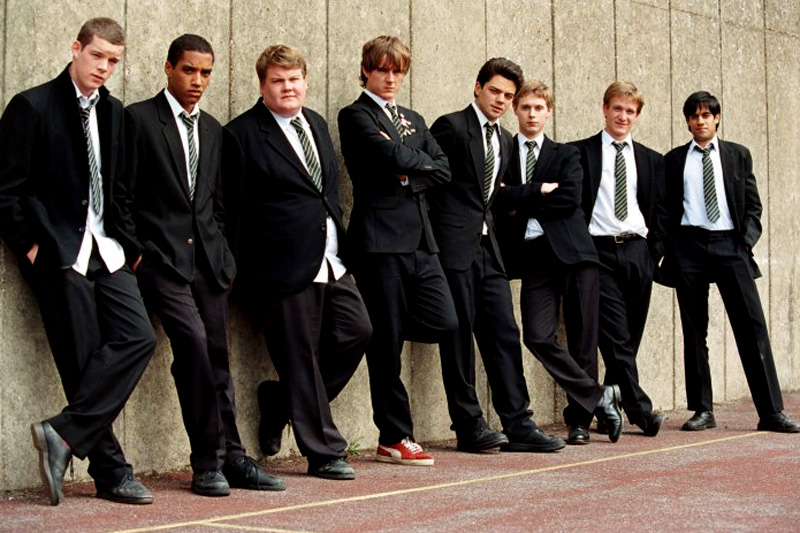
The History Boys


The History Boys packs a lot into a small movie because of the density of Alan Bennett's wit, which isn't just verbal irony, though verbal itony is all over the place in the film. His real interest shows up in an exchange like this:

Dakin: Do you think Poland was taken by surprise, sir?
Irwin: Possibly. But I'm pretty sure they knew something was up.

Or words to that effect. This turns out to be maybe the funniest moment in a very funny movie. And you can't explain why without totally spoiling the joke. But more than any preaching any character does--and the screenplay mercifully cuts down on the preaching in the play--the exchange addresses the movie's interest in the embodiment of ideas in persons, and people's retreat from life into ideas, and sex and power, and very refreshingly wins over the viewer to a sensibly adult view of the possibilities of sex outside of conventional better judgments. It is three-dimensional in its dramatuc structure and dialogue, even if it's a little two-dimensional in its portrayal of the external world.

It's a pretty sentimental story, Goodbye Mr. Chips played out in a world in which the possibility of a friendly blow job is overtly acknowledged (as it must have been sometimes in the real world a real Mr. Chips would have lived in). One kind of strange, sentimental lapse is the apparent failure to distinguish between Irwin and Hector, as if to overlook their differences in order to underline their similarities, which don't need any emphasis. The film seems to play it from a schoolboy point of view, as if what mattered was that one is kind of cool and thus holds more power than the other, who's sympathetic but with the emphasis on the "pathetic." But this is just a version of a very old-fashioned view of love as suffering and self-denial. Once in a while, while you're watching History Boys, you actually long to encounter an adult character who is as blithe about having a wank as a real human being might be.


And it's awfully good ensemble acting. It'd be a bit odd if these boys don't turn out to be the next generation of Jude Laws and Clive Owens.

Friday, December 15, 2006

Almost done grading, working on a conference proposal, looking forward to working on the poem for Colby's show and some other writing during the break. When I spend a lot of timne alone, I always start thinking about this poem by Coleridge:

THIS LIME-TREE BOWER MY PRISON

This Lime-Tree Bower My Prison
[Addressed to Charles Lamb of the India House, London]

Well, they are gone, and here must I remain,
This lime-tree bower my prison! I have lost
Such beauties and such feelings, as had been
Most sweet to have remembrance, even when age
Had dimm'd mine eyes to blindness! They, meanwhile,
Friends, whom I never more may meet again,
On springy heath, along the hilltop edge,
Wander in gladness, and wind down, perchance,
To that still roaring dell, of which I told;
The roaring dell, o'erwooded, narrow, deep,
And only speckled by the mid-day sun;
Where its slim trunk the ash from rock to rock
Flings arching like a bridge; —that branchless ash,
Unsunn'd and damp, whose few poor yellow leaves
Ne'er tremble in the gale, yet tremble still,
Fann'd by the water-fall! and there my friends
Behold the dark green file of long lank weeds,
That all at once (a most fantastic sight!)
Still nod and drip beneath the dripping edge
Of the blue clay-stone.

Now my friends emerge
Beneath the wide wide Heaven—and view again
The many-steepled tract magnificent
Of hilly fields and meadows, and the sea,
With some fair bark, perhaps, whose sails light up
The slip of smooth clear blue betwixt two Isles
Of purple shadow! Yes! they wander on
In gladness all; but thou, methinks, most glad,
My gentle-hearted Charles! For thou hast pined
And hunger'd after Nature, many a year,
In the great City pent, winning thy way
With sad yet patient soul, through evil and pain
And strange calamity! Ah! slowly sink
Behind the western ridge, thou glorious Sun!
Shine in the slant beams of the sinking orb,
Ye purple heath-flowers! richlier burn, ye clouds!
Live in the yellow light, ye distant groves!
And kindle, thou blue Ocean! So my friend,
Struck with deep joy, may stand, as I have stood,
Silent with swimming sense; yea, gazing round
On the wide landscape, gaze till all doth seem
Less gross than bodily; and of such hues
As veil the Almighty Spirit, when he makes
Spirits perceive his presence.

A delight
Comes sudden on my heart, and I am glad
As I myself were there! Nor in this bower,
This little lime-tree bower, have I not mark'd
Much that has sooth'd me. Pale beneath the blaze
Hung the transparent foliage; and I watch'd
Some broad and sunny leaf, and loved to see
The shadow of the leaf and stem above
Dappling its sunshine! And that walnut-tree
Was richly ting'd, and a deep radiance lay
Full on the ancient ivy, which usurps
Those fronting elms, and now with blackest mass
Makes their dark branches gleam a lighter hue
Through the late twilight: and though now the bat
Wheels silent by, and not a swallow twitters,
Yet still the solitary humble-bee
Sings in the bean-flower! Henceforth I shall know
That nature ne'er deserts the wise and pure;
No plot so narrow, be but Nature there
No waste so vacant, but may well employ
Each faculty of sense, and keep the heart
Awake to Love and Beauty! and sometimes
'Tis well to be bereft of promised good,
That we may lift the soul, and contemplate
With lively joy the joys we cannot share.
My gentle-hearted Charles! when the last rook
Beat its straight path along the dusky air
Homewards, I blessed it! deeming its black wing
(Now a dim speck, now vanishing in light)
Had cross'd the mighty Orb's dilated glory
While thou stood'st gazing; or, when all was still,
Flew creaking o'er thy head, and had a charm
For thee, my gentle-hearted Charles, to whom
No sound is dissonant which tells of Life.


(This poem is in the background of Songs, the last poem I did as a collaboration with Colby.)

Had a great note from R. J. March. I'd written to him to tell him I sent Dennis Cooper some praise of him to post on Dennis' blog on Porn Writing Day. He turns out to be a big DC fan, and thrilled to be brought to the Great One's notice. So it's always a good idea to let someone know you like their work; it's not like it's ever bad news.

Long phone call with Kelly and Phil on the dream education book. I'm working on a guide to proposing a course and on some ideas for teaching the "sociology" of the history of depth psychology, organizing study of anthropological perspectives on dreaming, the value of in-class dream workshops, and a few other topics.