Thursday, November 10, 2005

I Normally Don't Do This Kind of Thing . . .

but I do so enjoy the posts at TomCruiseIsNuts.com. Here's a sample:

November 7, 2005


Be afraid. Be very afraid.
The Cruiser hoping to convert Oprah to Scientology. Operation "Evil Celebrity World Domination" enters Phase 2 [insert evil laugh here].

From Bodog : "Tom Cruise plans to lay out $15 million to buy a place in Montecito, Calif., just two doors away from Oprah's $50 million estate! Are these two A-listers just really, really good friends -- or is something else going on? Is it chemistry -- or Scientology? According to a source, Tom, 43, wants to covert Oprah "I think he really thinks he can convert her. Tom seems really eager to lure Oprah into the church because he feels she would be a fantastic spokesperson and attract a whole new set of followers."

So it's finally here, the End of Days. Once they have Oprah, there will be no stopping them. We tried to warn you. So as there seems to be nothing we can do to stop this coming apocalypse, we've done the next best thing and found a way to profit from it! Check out the current odds at Bodog.com on Oprah's conversion. We plan to make some serious money on this... at least then we'll have enough funds to tithe to our future Scientology masters to avoid "re-education" at an "Oprah Camp".

November 3, 2005


"Eww! A girl is touching me! Get it off, get it off!"
Kidman "devastated" about the Cruiser's "baby"

From MSNBC : "Nicole Kidman is said to be “devastated” by the news that her ex-hubby, Tom Cruise, is about to have his first biological [cough, cough] child [spawn] with fiancĂ©e Holmes [CSCV] . And, although Cruise and Kidman are said to be in regular contact with one another, the buzz is that Kidman found out that he was an expecting dad from television. “Nic learned about Tom and Katie’s baby [spawn] the same way as everyone else — from the TV,” a friend of Kidman’s told Britain’s Grazia magazine. “She went shopping immediately after hearing the news to try and take her mind off it, but that just made things worse. She says people pointed at her, and everyone was whispering as soon as she turned her back. She’s taking it very hard.”

Of course, with the Cruiser's newly discovered "Remote Spawning" capability, she should be very careful what she wishes for, he could probably impregnate her cold, barren womb from Toledo. Oh, and Bewitched? Not funny.

November 2, 2005


Ex-Montreal Expos' mascot Youppi loses job. Vows bloody revenge on Martin Holmes.

"Grandpapa! Grandmama! I wuv you... NOW BOW DOWN BEFORE YOUR ALIEN CONQUEROR, HUMAN SCUM!"
The prenup saga continues. The Cruiser Spawn Carrying Vehicle (the CSCV) shakes up legal team. Youppi out, her father in. Youppi "devastated".

From MSNBC : "Holmes’s father, Martin, is a lawyer and is representing his daughter in the negotiations, reports the upcoming issue of The Star. Martin Holmes “is playing hardball with the prenup negotiations,” according to the tab, which quotes a source as saying that Holmes wants to make sure that his daughter will receive “a lump sum payment in the millions if the marriage should dissolve before the five-year mark.” Such terms are unusual for a prenup, which usually awards a spouse more money for a longer marriage, but, the source tells the mag: “The Holmes family would never tell Katie if they thought her marriage was doomed from the get-go, but they are pressuring her to hold out not only to protect her interests, but those of her child.”

Wow, have we just found the only sane people in this entire fiasco of a disaster of a train wreck of an Armageddon? Way to go Holmes family! Now if only you hadn't raised your daughter to be a complete moron who allowed herself to be impregnated by an alien space spawn, you guys would really be the best parents EVER! But, hey, 1 out of 2 ain't bad... at least you're getting a prenup! Mazel tov!

November 1, 2005

The Cruiser asks the Cruiser Spawn Carrying Vehicle (the CSCV) to sign a prenup. The CSCV displays brilliant legal mind and "Freaks out"


Katie's crack legal team, led by ex-Montreal Expos' mascot Youppi, comments on prenup. Thumbs up!
From upcoming Star: "Holmes was recently shocked when love-of-her-life Tom Cruise asked her to sign a prenup. "She's freaked out," the source says. "I think she thought it meant that he wasn't sure their relationship would last." [NO! well that thought certainly never crossed our minds] The source says that the idea of a prenup had never occurred to Katie. [but converting to his alien parasite religion was just fine] "She is head over heels in love with him and couldn't bear the thought that he might not be equally as in love," the source said. He told Katie that the prenup was for "her protection." [hey, wait a second... this sounds suspicious..] "He explained that at 43, he's more than 16 years older than she is," [okay...] said the source, "and although he's healthy, who knows what life has in store?" [uh-oh, we can see where this is going... here it comes, Katie...] Worried that he might die young like his dad, Tom told Katie, "he wanted to create a prenup so that she will always be taken care of, no matter what." [And, BINGO! Nice one Cruiser, very subtle. But, um, isn't that what the will is for? Not that we're lawyers or anything... Just wondering....]

Tuesday, November 08, 2005

Since You Asked
I think the classic definitions of the uncanny differentiate it from horror (and terror) as these are defined by one's physical responses to the object (whatever theories people have about the psychological sources of those feelings). The uncanny is both supernatural and disturbing or eerie--that is, one the one hand, it's defined by being inexplicable according to the ordinary operations of nature (thus, a rotting corpse is not uncanny though it may be an object of horror); on the other, by not being very nice (therefore miracles and God are not uncanny).
Freud's way of looking at the uncanny is interesting and very influential: It makes the familiar strange through some transformation that is generally to be explained as a psychological mechanism of defense, denial, alienation, and thus undermines our sense of the reality of reality, or ability to discern the real from the imagined, illusory, or subjective. Thus, typical uncanny themes are ghosts (much better when they are the ghosts of someone known); vampires (ditto, as they generally are in classic folklore); zombies (which confuse the categories or life and death); doppelgaengers (isn't that me? But I'm me!! Aaaaaagh!!!!). That's why my list tends to things like The Turn of the Screw, which are very decidedly ghost stories without necessarily being in the horror genre. Bartleby is interesting because, like Kafka and Borges, it skirts the issue of the supernatural. I am especially interested in situations where the uncanny effect is created not primarily by the device of a ghost, etc., but by a literary technique such as multiple points of view (as in Dracula or Rashomon), nesting of stories (as in The Manuscript Found at Saragossa), or weird narrative puzzles (as in Ubik). Personally, I think Stephen King is a very good writer of horror novels but only occasionally really interested in the uncanny, and then the effect is forced; Phillip K. Dick and Peter Straub are just deeply attracted to the uncanny. The title of Emmanuel Carrere's biography of Dick is pretty uncanny itself; at least it's extremely eerie: I Am Alive and You are Dead.
Unlike the basic category of the horror novel or film, the category of the uncanny fits pretty well with other things I teach, try to read up on, and hope to write more about: the nature of dreams; the theme of cannibalism in psychodynamics, esp. of childhood; and the identity issues posed by artificial persons in novels and film. On the latter, I think there's a lot in genuine philosophy and cultural theory lately, but very little that's psychodynamically oriented, so recognizing the continuity between , say, Blade Runner and Edgar Allan Poe on the living dead, automata, and doubles could be kind of interesting.
Dreyer, Vampyr

The Uncanny

I've been considering proposing a course on The Uncanny in Film and Lit. Unfortunately, I don't have time right now to go into why I'm feeling "The Uncanny" helps me to get at something I couldn't do with a course on Horror or The Gothic, but it basically comes down to seeing The Uncanny as an issue in representation rather than underlying beliefs--that is, the supernatural premise or incident is treated as defining subject matter and context for conventions in an analysis of the Gothic novel or the horror film, but I want to get instead at the creation of the sensation of the uncanny (and the conventions and premises, etc.) through the limitations and possibilities of representation, in narrative fiction and film. (Admittedly, this what a lot of theory-heads would do anyway, but I would be happier starting things out rightside-up by turning the conventional assumptions about the relation between reality and representation in art upside-down to begin with--that is, to admit, that supernatural belief is a function of narrative rather than assuming that narrative conveys supernatural belief.)
One reason I know this would be interesting for me to do is that the list of texts comes so easily:

Fiction
E. T. A. Hoffman
Keats - the gothic poerms
Poe (M. Valdemar, The Black Cat, The Tale-Tale Heart, Ligeia, William Wilson, a lot of others, really)
Washington Irving - The Stranger with a Bag, maybe Sleepy Hollow
Hogg - Private Memoirs and Confessions
Eliot - The Lifted Veil
Potocki - The Manuscript Found at Saragossa
Dostoevsky - The Double
Melville - Bartleby?
James - The Turn of the Screw, The Friends of the Friends
Dracula (esp. the uncanniness created by multiple and partial views)
Stevenson - Dr. Jekyll and Mr. Hyde
M. R. James, E. F. Benson
Six Characters in Search of an Author
Kafka - In the Penal Colony
Borges, Calvino
Shirley Jackson, Muriel Spark
Dick - Ubik, The Man in the High Castle
Peter Straub - Ghost Story
This leaves out, among other things, excerpting Montaigne, Thomas Browne, Robert Burton on considering the uncanny; and probably some orientation to the influence of Macbeth, Romeo and Juliet, and Hamlet on the Romantics' sense of the Uncanny. It'd be nice to find something in Hazlitt and DeQuincey.

Film

The Golem
The Student of Prague
Vampyr
The Dybbuk
Cat People
The Uninvited
Ugetsu
Rashomon
Kwaidan
Vertigo
Psycho
The Innocents
Invasion of the Body Snatchers
Les diaboliques
Rosemary's Baby
Total Recall
And in art generally, there'd be Goya, Fuseli, the Pre-Raphaelites, Surrealism, the Chapmans, Tony Oursler . . .

Key issues: This'd let me go into:
Anomalous psychological experience
Threats to identity
Dead/Alive
Real/Unreal
Doubles
Mulitiplicity of view, subjectivity, transcendentalism
Metaphysical paradox
Self-reference and Romantic irony
Gender and sexuality
I wouldn't base it on Freud, but a psychoanalytic view especially with a lot of Klein (reparation as haunting) would be good. Todorov. Mary Douglas probably has something relevant, too; structuralism is a very good approach for establishing the Uncanny.
I'd be very happy to have the chance to go into this while thinking about some of the films (I've never written up my talk on The Dybbuk for an article) and working on the Double novel.

Thursday, November 03, 2005


I'm very glad that my work--maybe that should read "work"--gives me the opportunity to read Divine Hunger: Cannibalism as a Cultural System, by Peggy Reeves Sanday. Normally, I don't have any interest in getting started on polemics in the classroom. And normally, I don't want to push psychoanalytically-inflected theories of behavior too hard. But I'm hoping some of the students in my Humanities course, as we discuss the Friday sections of Robinson Crusoe, Heart of Darkness, and some excerpts from Reeves' book and the cannibalism section in Gustav Jahoda's Images of Savages, will notice the connections between the rationales for cannibalism in some of the societies that practice it, as well as the fury directed at purported cannibals, and the justifications offered by the government of the United States for reserving the right to practice torture.
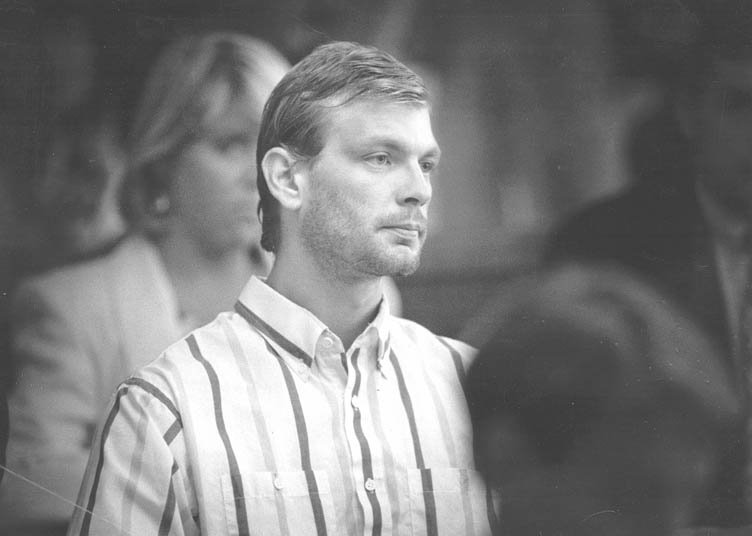
You can feel like something of a nutcase taking an interest in cannibalism at all, even when anyone who's considered it is aware of the deep relation between cannibalism and the roots of aggression, sadism, and violence (as well as the imagery of the nightmare, which is an area I'm primarily interested in)--and still more so when you are noting a connection in the psychology of Jeffrey Dahmer and George W. Bush. But it's there--not a whole lot more than in the rest of us, but then most of us don't, whether intentionally or incidentally, kill a whole lot of people.

Wednesday, November 02, 2005

I had been telling him how the Devil was God's enemy in the Hearts of Men, and used all his Malice and Skill to defeat the good Designs of Providence, and to ruine the Kingdom of Christ in the World; and the like. Well, says Friday; but you say, God is so strong, so great, is he not much strong, much might as the Devil? Yes, yes, says I , Friday, God is stronger than the Devil, and therefore we pray to God to tread him down under our Feet, and enable us to resist his Temptations and quench his fiery Darts. But, he says again, if God much strong, much might as the Devil, why God no kill the Devil, so make him do no more wicked?
I was strangely surpriz'd at his Question, and after all, tho' I was now an old Man, yet I was but a young Doctor, and ill enough quallified for a Casuist, or a Solver of Difficulties: And at first I could not tell what to say, so I pretended not to hear him, and ask'd him what he said. But he was too earnest for an Answer to forget his Question; so that he repeated it in the very same broken Words, as above. By this time I had recovered my self a little, and I said, God will at last punish him severely; he is reserv'd for the Judgement, and is to be cast into the Bottomless-Pit, to dwell with everlasting Fire: This did not satisfie Friday, but he returns upon me, repeating my Words, RESERVE, AT LAST, me no understand; but, why not kill the Devil now, not kill great ago?

Tuesday, November 01, 2005


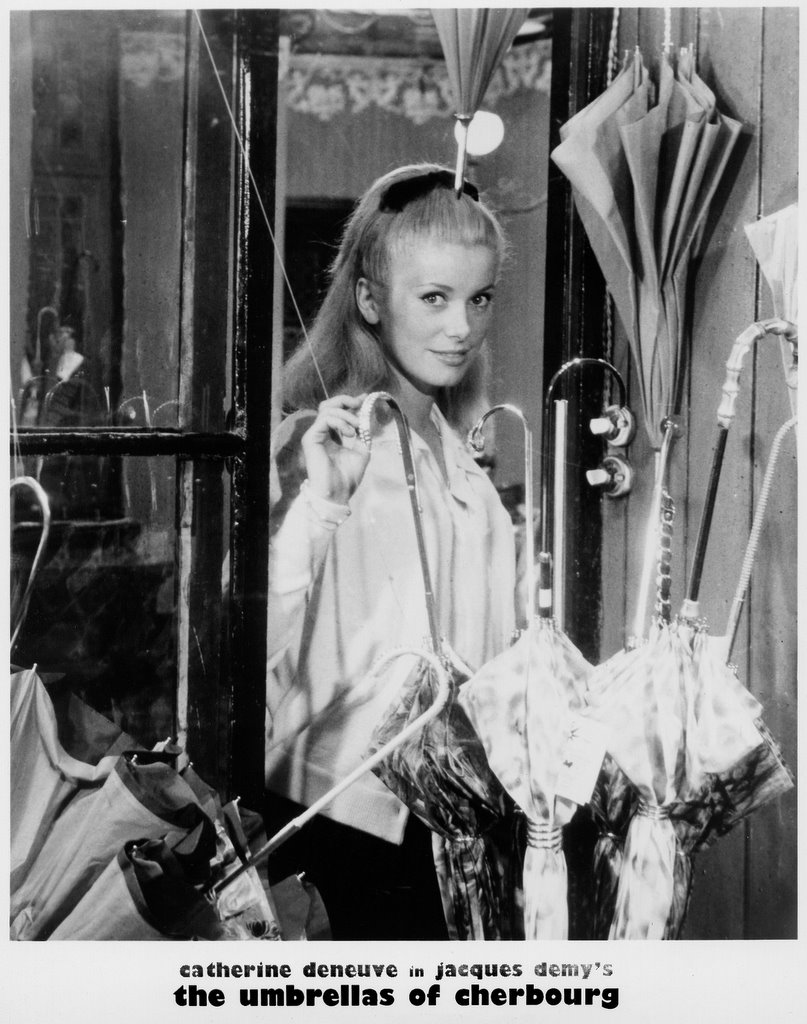
And Then There's The Umbrellas of Cherbourg
which has a weird sort of hidden relationship to The Threepenny Opera, which, when you think of it, is kind of inevitable--how many models are there for a really interesting 20th-century opera, self-consciously aware of its relation to the past? The relationship is coded into the musical score by Michel Legrand, which, I've always thought, has several moments that are precise transformations of The Threepenny Opera (which is also true of the American film version of Pennies from Heaven and of Stephen Sondheim's Sweeney Todd). But in The Umbrellas of Cherbourg, the irony swings the other way. The Threepenny Opera seems like a black-and-white film even when it's performed live on stage; The Umbrellas of Cherbourg is more "about" color than maybe any film outside of Paradjanov. The Threepenny Opera is one of the few entirely successful examples of political art in the twentieth century; The Umbrellas of Cherbourg is a self-consuming artifact of the growth of cinematic connoisseurship. It goes to the other extreme, but it works. I never quite understand people who say they don't get it. Maybe they expect it to be something other than it is. I wouldn't trade a good Douglas Sirk movie for it, but it's still great in the same way.

Sunday, October 30, 2005


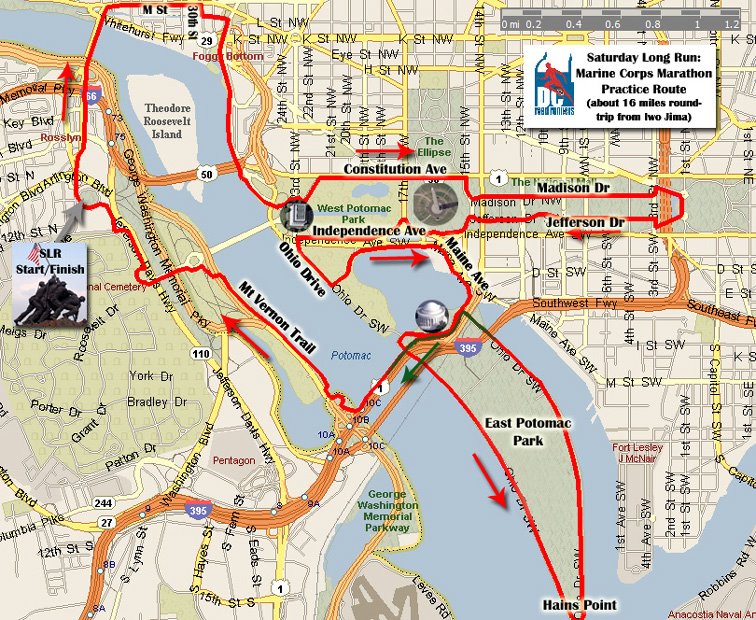
Is It Me, or Is There Something Just the Tiniest Bit Familiar About
the Route of the 30th Marine Corps Marathon?

Saturday, October 29, 2005

Now Look What You Made Me Do
Yesterday morning I spent a bit more than an hour revising my list of favorite movies. I'm still dizzy; I have papers to grade; I'm really into this idea for a new course; I've got three meetings coming up to plan; I have course descriptions to write for the department; and I actually have a short story sitting here for revision. But I worked on my favorite movies list for over an hour. Why? Because you, my public, all two of you, heckled me about it.
This officially makes me a blog nerd. Without any possibility whatever of getting rich off of it.
Cat People, Of Course, Cat People. But No David Fucking Lynch.

When I looked at my list, I was shoked--shocked--to discover I'd left a ton of my personal favorites off. I quickly revised my list to include: Cat People, La regle du jeu, Days of Heaven, If . . ., Man with a Movie Camera, Rashomon, The Searchers, A Matter of Life and Death, L'Atalante . . . I revised the order, too, but I'm not going to post the whole list now because:
I Don't Want to Get Started on This with You, Dude
But I have to say that I have an auxiliary list of movies I have to see again sometime before I decide whether they're among my absolute favories, or movies I've never seen but imagine will be among my absolute favorites once I get around to them, including:

A One and A Two . . .
Andrei Roublev
Belle de jour
Celine and Julie Go Boating
Close-Up
Daisies
Day of Wrath
Fanny and Alexander
Gertrud
La Belle Noiseuse
Les dames du Bois du Boulogne
Let’s Scare Jessica to Death
McCabe and Mrs. Miller
Mirror
Notorious
Oharu
Ordet
Pierrot le fou
Sansho Dayu
Silence of the Palace
The Curse of the Cat People
The Home and the World
The Innocents
The Story of the Late Chrysanthemums
Z
There is probably nothing so interesting as a list of someone's favorite movies. I went through the Sight and Sound 2002 survey of directors' and critics' Top Tens yesterday, too, and they were often interesting, often irritating. (Irritating: People who put Schindler's List, Gone With the Wind, Jaws, Blade Runner or The Piano on their Top Ten lists; people who leave off Citizen Kane because it's "the definitive white male movie"; and really, is there anything as pretentious as pretending that Rope is your favorite Hitchcock movie?) There's just this very clear line between people who like movies because they're good movies, and people who like movies because they approve of what they're saying, or want to be perceived as approving of what they're saying, whether they actually do or not, or want to be associated with some specious glamor, aura, or depth they imagine the film represents. I could just spit.
But nobody, including me, really much wants a list of actually, really, seriously good movies. It's more interesting to do a list of movies you know not everyone likes or even sees but that are somehow to your taste. And this is the thing about criticism in the recently morbid age of theory: the totally dumb smart-guy pose of supposedly avoiding the vicissitudes of personal taste while at the same time establishing an if-you-have-to-ask-why-you'll-never-understand Canon of Cool. (There's not a thing wrong with jazz, for example; it's academic talk about jazz that kills all the joy in life.) And that is why people like Dave Hickey: He elaborates on his taste, like Baudelaire, or Frank O'Hara. Oh, but you knew that.
Oh Crap, I Left Off Rosemary's Baby
My short list of movies not everyone loves that I can watch over and over again--the personal sensibility list:

Discreet Charm of the Bourgeoisie
The 5,000 Fingers of Dr. T
Bride of Frankenstein
Imitation of Life
The Gang’s All Here
Hiroshima mon amour
The Celebration
Invasion of the Body Snatchers
RoboCop
Shadow of a Doubt
Week End
Providence
Ohayo
If . . .
A Slave of Love
Love Me Tonight
Law of Desire
Mon oncle d’Amerique
Targets
W.R.: Mysteries of the Organism
All That Heaven Allows
Topsy-Turvy
Cat People
The Devil, Probably
Thundercrack
A Matter of Life and Death
Trash
The Idiots
The Long Day Closes
Double Suicide
The Miracle of Morgan’s Creek
The Terminator
The Dybbuk
Theatre of Blood
Boggy Depot
Talk to Her
Scenes from the Class Struggle in Beverly Hills
God Told Me To
The Uninvited
The Crime of M. Lange
Last Summer in the Hamptons
Black Moon
The Haunting
Die, Mommie, Die
Devi
Scotland, PA
Sex and Zen
Dracula’s Daughter
And now I'm going back to work.

Friday, October 28, 2005

History for Snot-Nosed Leftist Bastards
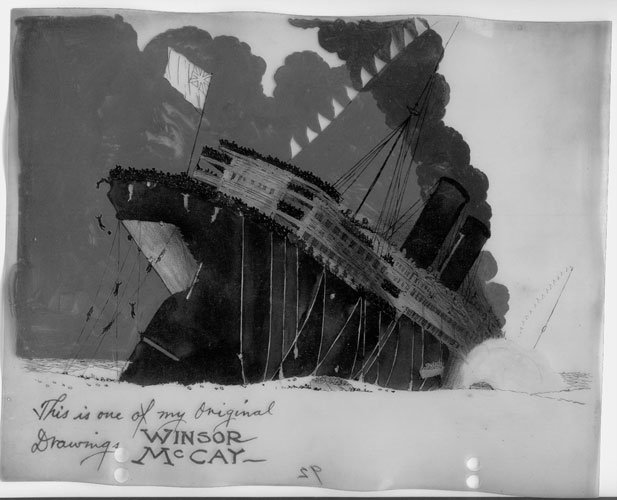
I've been thinking this would be a very good time to know more about the role of the sinking of the Lusitania in bringing the United States into World War I. It could make a very good premise for a play. (The sinking of the Maine is the same kind of thing but is a better-known story, and has less ambiguity, I think.) No one says it wasn't a catastrophe--but how did it happen? Did anyone argue it was being used as a pretext? There might be an opportunity for some nice arguing.
File Under "Good Advice"
When you start a blog--and you will--never post a list of your favorite movies.

Wednesday, October 26, 2005

My Brain Hurts
I'm trying to do notes for my cinema class tomorrow--summarizing Ernest Hartmann on dream as metaphor, Mark Blechner on dream as extralinguistic thinking, Medard Boss, Fritz Perls, and a lot of what is obviously too much stuff to cover in one session--and for some reason my mind keeps wandering back to De Qunicey's essay, "On Murder Considered as One of the Fine Arts." Maybe it's because when I am actually taking up an intellectual subject and making some pretense of treating it analytically, I slip into self-parody--and there isn't a better satire of the academic dilettante holding forth than De Quincey's essay.
It is a dry kind of humor:
My infirmity being notoriously too much milkiness of the heart, I find it difficult to maintain that steady equatorial line between the two poles of too much murder on the one hand, and too little on the other. . . . I believe, if I had the management of things, there would hardly be a murder from year's end to year's end.
My great discovery a few weeks back was that I'd really like to do a class on Sex and Sexuality in Cinema, so ideas about it pop into my head from time to time. My great discovery this week has been that I'd really like to do a class on The Uncanny in Film and Lit--not the Fantastic, as I've sometimes thought, but the Uncanny precisely because, to put it crudely, when theorists make the Fantastic their subject of study they begin with an idea of some class of things represented in lit or film--whereas I am interested in looking at the Uncanny, the sense of the uncanny, as a product of representation itself, not something represented. That is, the seeing the ghost, say, comes first, as a product of the problems in how we see, then the belief about ghosts. The perception of the fact of mortality necessarily creates the idea of immortality, as an idea one can play with in literature, art, belief systems. The problem, as in medieval proofs of the existence of God, is in a representational theory of thought and language--in assuming that the fact that something can be thought of is somehow an argument for even the possibility of its existence, rather than a feature of how representation works.
This would be much more interesting if one were applying it to Poe, or The Uninvited, or that very hit-or-miss TV show, Medium.
Shuffle function
Mahler's Sixth Symphony

Tuesday, October 25, 2005

So I was in New York at a conference Thursday and Friday, everything went fine, I was smart and funny and met interesting people, and Saturday morning I woke up with Vertigo--like, seriously, the room spinning round and round. Poor Grady had to get me to the emergency room as I kept throwing up; doctors looked at me, said, "Yeah, you've got vertigo, all right, isn't it the darnedest thing?" and I spent the night in the hospital. Now I'm back and walking a little bit like a drunk, otherwise OK but not quite ready to stare at a screen for any length of time.


So this may be as good a time as any to insert the list of my 97 (so far) favorite movies, which I made to kill time and clear my head, playing around at http://www.imdb.com. This kind of list is an awful lot of fun to do, especially the minute differences in favor one accords various entries--Do I really love All About Eve more than North by Northwest--and almost all my choices will seem incredibly pedestrian, except, of course, for the ones that are bizarre and inexplicable. I'm putting the list here because it's such a Live-Journal, What-kind-of-tree-would-you-be kind of thing to put on your blog but also as a reminder that even if Vertigo is my number 10 here, I would:
1) Happily watch it more often than most of 1-9, for what that's worth
2) Gladly avoid actual vertigo for the rest of my life because it really sucks.


Citizen Kane
City Lights
Dr. Strangelove
Wild Strawberries
Earth
Double Indemnity
Bride of Frankenstein
The Grapes of Wrath
Pinocchio
Vertigo
Children of Paradise
Imitation of Life
The Man Who Shot Liberty Valance
Bicycle Thieves
La Jetee
Persona
Sunset Blvd.
M
Discreet Charm of the Bourgeoisie
The Wizard of Oz
The 5,000 Fingers of Dr. T
South Park: Bigger, Longer & Uncut
RoboCop
Orphee
Rome, Open City
Modern Times
His Girl Friday
The General
Hiroshima mon amour
Metropolis
All About Eve
North by Northwest
Rear Window
Sherlock, Jr.
Nashville
Invasion of the Body Snatchers
Zero de conduite
Closely Watched Trains
Duck Amuck
Law of Desire
The Celebration
Week End
A Zed and Two Noughts
Topsy-Turvy
Mon oncle d’Amerique
A Slave of Love
Ohayo
Stagecoach
Grand Illusion
Wings of Desire
The Idiots
Ugetsu
The Terminator
Targets
Fantasia
Eternal Sunshine of the Spotless Mind
Waking Life
W.R.: Mysteries of the Organism
Trash
Terminator II
Sullivan’s Travels
Double Suicide
Shadow of a Doubt
Providence
Pennies from Heaven
The Passion of Joan of Arc
The Lady Eve
Pickpocket
Kameradschaft
The Gang’s All Here
Cecil B. Demented
Y tu mama tambien
Kagemusha
The Maltese Falcon
Boggy Depot
Forbidden Planet
The Conformist
Breathless
Velvet Goldmine
Pee-wee’s Big Adventure
Hamlet (2000)
Scotland, PA
Death in Venice
Gattaca
The Devil, Probably
Apocalypse Now
Thundercrack
Before Night Falls
Die, Mommie, Die
The Women
Theatre of Blood
Black Moon
Prospero’s Books
Peeping Tom
Dark Eyes
Ninotchka
God Told Me To

Wednesday, October 19, 2005

I Work My Ass Off
Today I can't say anything at all because I'm working on a conference presentation. I have to focus all my energies on remaining human and sticking with what I actually find interesting about the subject so that it doesn't generate into exactly what you think of when you hear the phrase "a conference presentation. I mean, the energies I'm not using in fretting, catastrophizing, and self-flagellating. I'll be back on the weekend.

Monday, October 17, 2005

More About Dionysos
For Vernant, Dionysos was the god who crosses the boundaries and confuses reality and illusion, who makes us lose in his collective our self-
consciousness and identity of self. Tragedy is appropriately Dionysiac when we suspend our disbelief in watching the drama and enter a world of
mimesis, a world presided over by the mask behind which individual identity is hidden.

-Storey and Allan, Guide to Ancient Greek Drama (Blackwell)

That's fine, but "lose" should be in quotation marks, because self-consciousness and identity aren't "lost," they're simply relegated to another part of awareness. The "confusion" of reality and illusion in drama is itself an illusion, responsible for a lot of the enjoyment of illusion in art. This seems to be the easiest thing in the world to get confused about, but it does remind us that the inadequacy of our ways of describing "illusion" is due to the inadequacy of our ways of describing "reality."
Really, someone ought to do something about it.


Stop Me If You've Heard This One Before

The entire comedy of art is neither performed for our betterment or education nor are we the true authors of this art world. On the contrary, we may assume that we are merely images and artistic projections for the true author, and that we have our highest dignity in our significance as works of art--for it is only as an aesthetic phenomenon that existence and the world are eternally justified--while of course our consciousness of our own significance hardly differs from that which the soliders painted on canvas have of the battle represented on it. Thus all our knowledge of art is basically quite illusory . . .
--Nietzsche, Birth of Tragedy

Saturday, October 15, 2005

A work of genius seems impeccable: Although you can enjoy thinking about how human minds put it together, you experience it as you do a work of nature. There's no reason for analysis to consider how it might be done differently, because all its parts are understood as existing only in relation to the whole. That is how a work of genius transcends conventions, rules, codes, and why it's an error to try to reduce it to its place in the systems that give rise to it and through which it operates--not because it is "universal" or embodies some timeless message but because it works very, very well, as an art-machine.

Friday, October 14, 2005

Too Much God
The exercise in my Humanities course this week was to propose a production concept for The Bacchae, then meet in small groups to choose one for a theater company to go with and offer a pitch for. Three of four groups chose to put it in a contemporary setting, with a show-down between religious and secular forces, although, interestingly, some groups saw the play as about religious hysteria infecting the populace and others saw it as bureaucratic culture unable to deal with the inevitable irrational forces represented by religion. Practically everyone says they have a huge problem with organized religion; practically no one knows anything about it. (The previous week, no one was familiar with even the idea of the proscriptions of Leviticus or their cultural context, since almost everyone imagines, as you would if you got your ideas about the Bible from television, that there's some undisputed short list of laws you're either for or against that come packaged with their own obvious interpretations.)
Which is only to confirm what you know already: People are experiencing the stand-off between religious and secular views as the dominating polarizing issue of the times, although this isn't saying anything about how they characterize that polarization. For example, almost everyone who says they have problems with organized religion is careful to pay respect to "faith" and "everyone's right to believe what they wish" (as if your beliefs were a matter of choice rather than unconscious forces you'd do well to consider carefully)--to the point that they take offense when I mention that Freud found the survival of supernaturalist beliefs into the 20th century embarrassing and demoralizing, or to the point where they insist that "skepticism" is "a belief system" just as religion is (or intelligent design--I cannot accord it the dignity of capitalization--a "theory" just like evolution). Nor do they particularly want to take on the resemblances between Christian fundamentalism and Islamic fundamentalism (or recently, constitutional fundamentalism).
A Still, Small Voice
As always happens with these rants, I eventually lose it--there's nothing out there, no social or cultural phenomenon, that I can find irritating enough to completely overcome my natural tendency to sink into embarrassed silence as I observe myself opinionating. What I'm ranting about becomes less interesting to me than the fact that I'm ranting.
I was going to get around to saying something about Dionysus and Nietzsche, but that'll have to wait.

Friday, October 07, 2005

Dreams
I was working with a whole writing staff on the script for a new Scooby-Doo feature film, only it was going to be done in claymation, like Wallace and Grommit. I was excited about this and thought of it as a genuine aesthetic advance; somehow this was going to help make the script urbane, multi-layered, relevant. I was unsure about whether to reveal that I've never seen a Scooby-Doo cartoon but it turned out that wasn't really expected. What I was supposed to contribute was based on my background in classic film and theater conventions, especially Shakespeare. It was going to be hilarious and brilliant.

Thursday, October 06, 2005

This Just In
George Bush's right-wing base is now complaining that the Harriet Miers appointment shows he isn't conservative enough. They added that hell is too cold, the Pope isn't actually Catholic, and Hitler wasn't enough of an asshole.

Wednesday, October 05, 2005

Stop Me if You've Heard This One
George Bush is getting his morning report from his staff. Someone says,
"Mr. President, I'm sorry to tell you that three Brazilian soliders were killed in Iraq yesterday."
Bush stares in shock, the color drains from his face. "Th-that's awful," he cries, and sinks his head into his hands on the table.
The staff is stunned. He's never reacted so emotionally to any war news before.
After a moment, the president raises his head and says,
"Exactly how many is a bazillion, anyway?"

This is an actual joke now circulating on the internet, which means not only that you've probably heard it already, but that 80 million Chinese will be totally confused by it by the end of the week.

Prolonged Hilarity Ensues
Oh yes, I think a lot about humor. Last night we saw Urinetown, great show, great production at Signature Theater in Arlington. In any artform, there's a kind of funny you can get at only by exploiting the contract between artists and audience to accept certain conventions. To expose the conventions is funny in itself (but can be wearing, as it sometimes is in the self-conscious narration in Urinetown, which is meta-funny: It not only is a Brechtian alienation effect but refers to its being a Brechtian alienation effect, and though this doesn't make it any funnier, it certainly argues for its being "postmodern." Oh God, shoot me now, someone, and put me out of my misery.)

But the more fun kind of funny in this production of Urinetown comes from direct parody, wry allusions to basic conceits of musical comedy over the years, exposing not only their conventions but their incongruities (like ending a Les Miz-style number about poverty and woe with . . . jazz hands!!). Why have so many people who have tried to understand humor insisted that it's "fundamentally" one thing or another?--for Bergson, perception of the incongruity of humans behaving mechanistically, for Freud defusing an anxiety reaction, for so many modern humortists, just pain, pain, pain. For example, the next subhead works on many levels.

He Gave Good Subhead
The problem is, I just don't know which of those levels is the most annoying.

Sunday, October 02, 2005

Dreams
Terrible dreams last night. I woke up at 4 am from a dream in which I was abducted by this Satanist cult led by Christopher Lee. We were in an upper room of a church or cathedral and he was torturing people, slashing them with knives. I had to look on without doing anything or it'd happen to me.
Whenever I have a dream like this, I assume immediately that it has something to do with work and authority conflicts.
After I fell asleep again, I dreamed I was in class and no one was doing the work; this flipped around, and I was a student in a class who hadn't done the work. This in itself is pretty interesting. I always assume it's a universal that hasn't been given much emphasis but maybe it's just a prominent feature in my own dreams: the ability of dreams to vary your point of view and erase the subject-object distinction seems an absolutely central feature. It's the reason I've made such a big deal about Whitman's The Sleepers; it seems like he's on to something about dreaming that doesn't really enter into the big twentieth-century psychological theories, at least until recently. Perhaps the fundamental characteristic in imagination of being able to construct different viewpoints from which to observe the world--as in, for example, even being able to imagine outer space enough to conjecture or develop theories about it--is always active and simply most noticeable during sleep or trance states because of the relaxation of the ego's hold over processing of perceptions. This is undoubtedly a very well-known idea I just don't happen to be familiar so I imagine it's obscure.